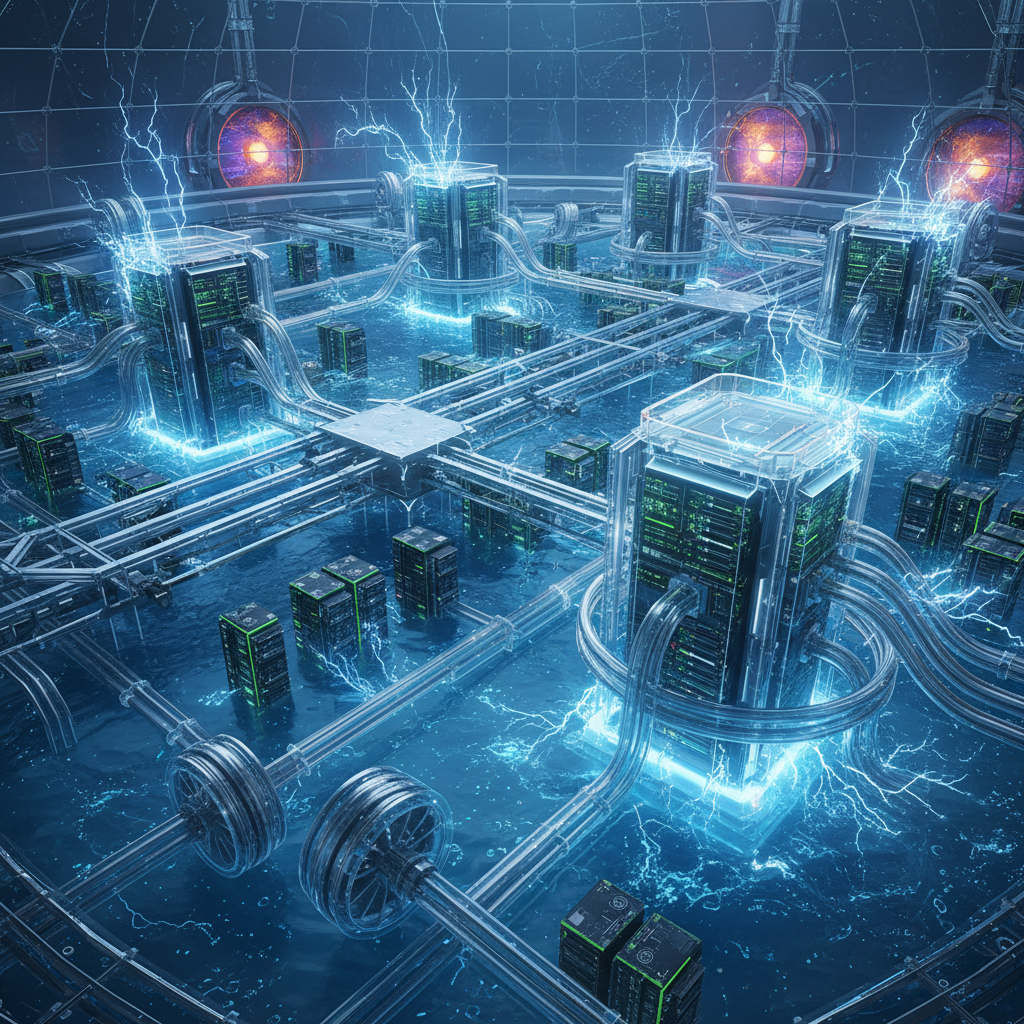
The Silent Crisis Behind the Generative AI Revolution
The artificial intelligence revolution is facing a physical wall. While the world fixates on the extraordinary computational capabilities of the latest silicon architectures, a fundamentally different bottleneck is quietly constraining global progress.
During a high-profile industry address on May 20, 2026, Nvidia CEO Jensen Huang explicitly identified the constraints of traditional data center infrastructure, pointing to a staggering $200 billion new market opportunity focused entirely on thermal management and energy distribution.
The math is unforgiving. As the thermal design power (TDP) of next-generation accelerators like the B200 Blackwell eclipses 1,000 watts per chip, the physics of moving air across metal heatsinks has reached its absolute limit. Air simply lacks the volumetric heat capacity required to extract this much thermal energy quickly enough.
This physical reality forces operators into a corner: they must transition to liquid cooling architectures, or face severe throttling of their multi-billion dollar GPU clusters. The transition is no longer optional; it is the critical path to sustaining the AI boom.
Beyond the Silicon: The Data Center Power Grid Bottleneck
The discourse surrounding artificial intelligence frequently centers on chip supply shortages, yet the true scarcity lies in gigawatts. Modern hyperscale data centers require enormous amounts of uninterrupted electricity.
A standard facility housing tens of thousands of H100 or next-generation GPUs can draw upwards of 150 megawatts (MW) to 300 MW of power. To put this in perspective, this is equivalent to the power consumption of a small to medium-sized city.
“The constraint on computational scaling is no longer lithography or fabrication capacity; it is the localized availability of high-voltage transmission lines and the thermal dissipation infrastructure required to manage unprecedented energy densities,” suggests a 2025 study published in the IEEE Transactions on Cloud Computing by researchers at the Massachusetts Institute of Technology (MIT).
This energy density crisis is reshaping commercial real estate and grid planning. Data center operators are facing multi-year backlogs for electrical substation components, particularly high-voltage transformers.
If you have ever considered the benefits of running local models to bypass this massive centralized infrastructure, you might want to explore how to build your own free local AI agent in 2026, which operates on a fraction of the power footprint.
The Physics of Heat Extraction: Why Air Fails
To understand the $200 billion trade, one must understand the basic thermodynamics at play inside a modern server chassis. Heat transfer efficiency is governed by the thermal conductivity of the medium.
- Air: Has a thermal conductivity of approximately 0.026 W/(m·K) at room temperature. It is an excellent insulator, but a terrible conductor.
- Water: Has a thermal conductivity of roughly 0.6 W/(m·K), making it more than 20 times more effective at transferring heat than air.
- Engineered Dielectric Fluids: Used in immersion cooling, these fluids offer precise boiling points tailored for phase-change heat extraction.
When a server rack exceeds 40 kilowatts (kW) of power draw, pushing chilled air through the rack requires massive, loud, and inefficient fan arrays. These fans themselves consume up to 15% of the total rack power, creating a parasitic drain on the facility.
Furthermore, air cooling creates “hot spots.” Uneven airflow leads to thermal throttling, where the CPU or GPU deliberately slows its clock speed to prevent catastrophic melting. In a cluster of 10,000 GPUs training a massive language model, a single throttled node can bottleneck the entire network.
Direct-to-Chip (D2C) vs. Immersion Cooling Architectures
The liquid cooling market is bifurcating into two primary technological trajectories, each with distinct advantages, supply chains, and investment profiles.
Direct-to-Chip (D2C) Cold Plates
Direct-to-chip cooling represents the most immediate retrofit opportunity for existing data centers. In this architecture, a highly engineered copper or aluminum “cold plate” is mounted directly over the GPU and CPU dies.
A closed-loop system pumps a coolant mixture (typically water and glycol) through micro-channels within the cold plate. The coolant absorbs the heat, flows out of the rack to a heat distribution unit (CDU), and transfers the heat to the facility’s primary chilled water loop.
According to an analysis in the Journal of Electronic Packaging (Stanford University, 2025), D2C systems can effectively manage rack densities up to 120 kW, capturing approximately 75% to 80% of the server’s total heat output.
The remaining heat—generated by memory modules, voltage regulators, and network switches—must still be removed via traditional air cooling, necessitating a hybrid approach.
Two-Phase Immersion Cooling
Immersion cooling represents the radical, long-term future of high-density computing. In this setup, the entire server motherboard is submerged in a bath of non-conductive, engineered dielectric fluid.
In two-phase immersion, the fluid is engineered to have a low boiling point (often around 50°C). As the chips generate heat, the fluid directly contacting them boils, turning into a vapor. This phase change absorbs massive amounts of latent heat.
The vapor rises to the top of the sealed tank, condenses on cooling coils, and rains back down as liquid. This system is near-silent, eliminates all server fans, and can handle rack densities exceeding 250 kW.
Interestingly, the extreme focus on precise temperature control for optimal system performance mirrors biological necessities; for example, a 1°C drop guarantees 2x deeper sleep for humans, proving that optimal thermal states are universal performance drivers across both biology and silicon.
The Investment Thesis: Mapping the $200B Value Chain
The $200 billion market valuation cited by Jensen Huang is not solely about the cooling fluids; it encompasses a vast, multi-layered supply chain that is currently racing to scale up production.
Investors are looking far beyond the chip designers and foundry operators. The real alpha lies in the unglamorous, highly specialized components of thermal management and power delivery.
- Coolant Distribution Units (CDUs): The heart of any liquid cooling system. These complex pumping stations manage flow rates, pressure drops, and filtration. Leading manufacturers are seeing multi-year order backlogs.
- Manifolds and Quick Disconnects (QDs): High-precision, leak-proof valves are non-negotiable. A single drop of water on a $40,000 GPU is catastrophic. The aerospace-grade engineering required for QDs creates a massive barrier to entry.
- Specialty Chemicals: Manufacturers of engineered fluorinated fluids and PFAS-free alternatives for immersion cooling stand to generate massive recurring revenue, functioning essentially as the “oil” of the AI economy.
This ecosystem is highly fragmented, presenting immense opportunities for consolidation and margin expansion. Legacy HVAC providers are scrambling to acquire specialized liquid cooling startups to remain relevant in the hyperscale era.
Power Usage Effectiveness (PUE) and the Sustainability Mandate
Beyond the technical necessity, liquid cooling is being driven by intense regulatory and environmental pressures. Governments worldwide are scrutinizing the massive energy footprint of generative AI.
The industry standard metric for efficiency is Power Usage Effectiveness (PUE). A PUE of 1.0 represents theoretical perfection, where 100% of the energy goes to computation and 0% to overhead (like cooling and lighting).
Traditional air-cooled data centers struggle to achieve a PUE below 1.4 or 1.5. In contrast, fully optimized liquid cooling facilities, particularly immersion setups, consistently report PUEs between 1.03 and 1.05.
“Transitioning from legacy air-assisted cooling to two-phase immersion architectures offers a theoretical carbon footprint reduction of up to 40% for hyperscale workloads, independent of the energy source,” notes a comprehensive 2026 report from the International Journal of Sustainable Computing (Cambridge University).
Furthermore, liquid cooling enables efficient heat reuse. The high-temperature return water from AI clusters (often exiting at 60°C to 70°C) is highly suitable for integration into municipal district heating systems.
This transforms the data center from a pure energy consumer into a thermal utility, offering cities a decarbonized heat source for residential and commercial spaces. European hyperscalers are already leading this integration.
The Edge Computing Overlap: Liquid Cooling in Compact Spaces
The necessity for liquid cooling is not confined to massive, warehouse-scale hyperscale facilities. The proliferation of AI at the edge demands extreme thermal management in highly constrained environments.
Telecommunications providers, factory automation systems, and autonomous vehicle infrastructure require immense local compute power to reduce latency. Air cooling is often unviable in these harsh, dusty, or spatially constrained environments.
Sealed, liquid-cooled micro-data centers are becoming the standard for 5G towers and edge deployments. The ability to deploy high-density compute without relying on external ambient air quality is a massive paradigm shift.
This shift to edge AI processing is deeply intertwined with wearable technology; just as audio-powered smart glasses just killed the screen by relying on localized AI compute, the physical infrastructure supporting these localized models must shrink, necessitating compact, liquid-cooled edge nodes.
Supply Chain Vulnerabilities and Geopolitical Risks
The transition to liquid cooling introduces new vulnerabilities into the AI supply chain. The materials required for advanced cold plates, high-grade copper, and specific polymer sealants are subject to global commodity fluctuations.
More critically, the engineered fluids used in immersion cooling have historically relied heavily on PFAS (per- and polyfluoroalkyl substances). Due to severe environmental and health concerns, the European Union and the US EPA are aggressively phasing out PFAS.
The chemical industry is engaged in a frantic race to develop performant, PFAS-free dielectric fluids. The companies that successfully patent and scale these eco-friendly coolants will effectively monopolize a multi-billion dollar recurring revenue stream.
Additionally, the specialized manufacturing capacity for leak-proof, zero-drip quick disconnects is highly concentrated. Any disruption in this specific manufacturing niche directly throttles the deployment of new AI server racks globally.
Financial Models: Capex vs. Opex Dynamics
For data center operators, the shift to liquid architectures fundamentally alters the financial modeling of their facilities. The initial Capital Expenditure (Capex) for liquid infrastructure is undeniably higher.
Retrofitting a facility with CDUs, specialized plumbing, and reinforced floor loading (water is heavy) requires significant upfront investment. However, the Operational Expenditure (Opex) narrative is dramatically different.
Liquid systems eliminate the massive electricity draw of rack fans and computer room air handlers (CRAHs). They allow for higher density racks, meaning operators can pack more compute into less square footage, increasing the revenue-per-square-foot yield.
A rigorous financial analysis published in the Journal of Data Center Finance and Economics (Wharton School, 2024) suggests that the Return on Investment (ROI) for liquid cooling retrofits in high-density AI clusters is achieved in just 14 to 18 months purely through Opex energy savings.
The Future: Quantum Computing and Beyond
As we look toward the 2030 horizon, the thermal management infrastructure being built today for Generative AI will serve as the foundational bedrock for the next computational leap: practical quantum computing.
While quantum systems require cryogenic cooling (approaching absolute zero), the classical computing clusters that orchestrate, correct errors, and interpret quantum data will require massive, dense compute power co-located with the quantum cores.
The liquid cooling ecosystems, plumbing standards, and heat extraction methodologies standardized during this current AI boom will directly enable the hybrid quantum-classical data centers of the next decade.
The $200 billion trade identified by Jensen Huang is not a temporary trend; it is the permanent physical re-engineering of the internet’s backend. The era of the air-cooled data center is drawing to a close.
Conclusion: The Defining Infrastructure Play of the Decade
The artificial intelligence bottleneck is not a software problem, nor is it strictly a semiconductor problem. It is fundamentally a thermodynamic and electrical distribution challenge.
As the industry pushes the boundaries of silicon physics, the companies that provide the pumps, fluids, manifolds, and electrical transformers are quietly becoming the most critical players in the AI value chain.
Investors and technologists alike must look past the flashy model benchmarks and understand the physical realities of the server room. The $200 billion liquid cooling market is the foundation upon which the entire AI economy must be built.
Without adequate thermal extraction and power delivery, the greatest algorithms in the world will remain trapped inside melted silicon. Liquid cooling is not an accessory; it is the ultimate enabler of the intelligence age.
#AIBottleneck #LiquidCooling #JensenHuang #DataCenter #ThermalManagement #ImmersionCooling #TechInvesting #GenerativeAI #GreenTech #Nvidia #Infrastructure #FutureOfCompute
Leave a Reply