
If you are still buying Nvidia stock in late 2026, you are buying the brand name, not the bottleneck. The amateur retail investors are mesmerized by the software—they cheer for OpenAI’s GPT-5.5, they debate the merits of Anthropic’s Claude 4.7, and they marvel at the sleek design of Nvidia’s Blackwell chips. But the smart money on Wall Street has already rotated. They understand a brutal, unyielding truth of the physical world: Software is just math, and AI chips are just blueprints. None of it exists without the microscopic manipulation of silicon. The true, absolute monopoly of the artificial intelligence supercycle does not reside in Silicon Valley; it resides in Taiwan. Taiwan Semiconductor Manufacturing Company (TSMC) just released their Q1 2026 earnings, and the numbers are so violent, so historically unprecedented, that they broke financial forecasting models. If you want to own the foundational bedrock of the AI revolution, you must understand why TSMC is the most dangerous, indispensable company on Earth.
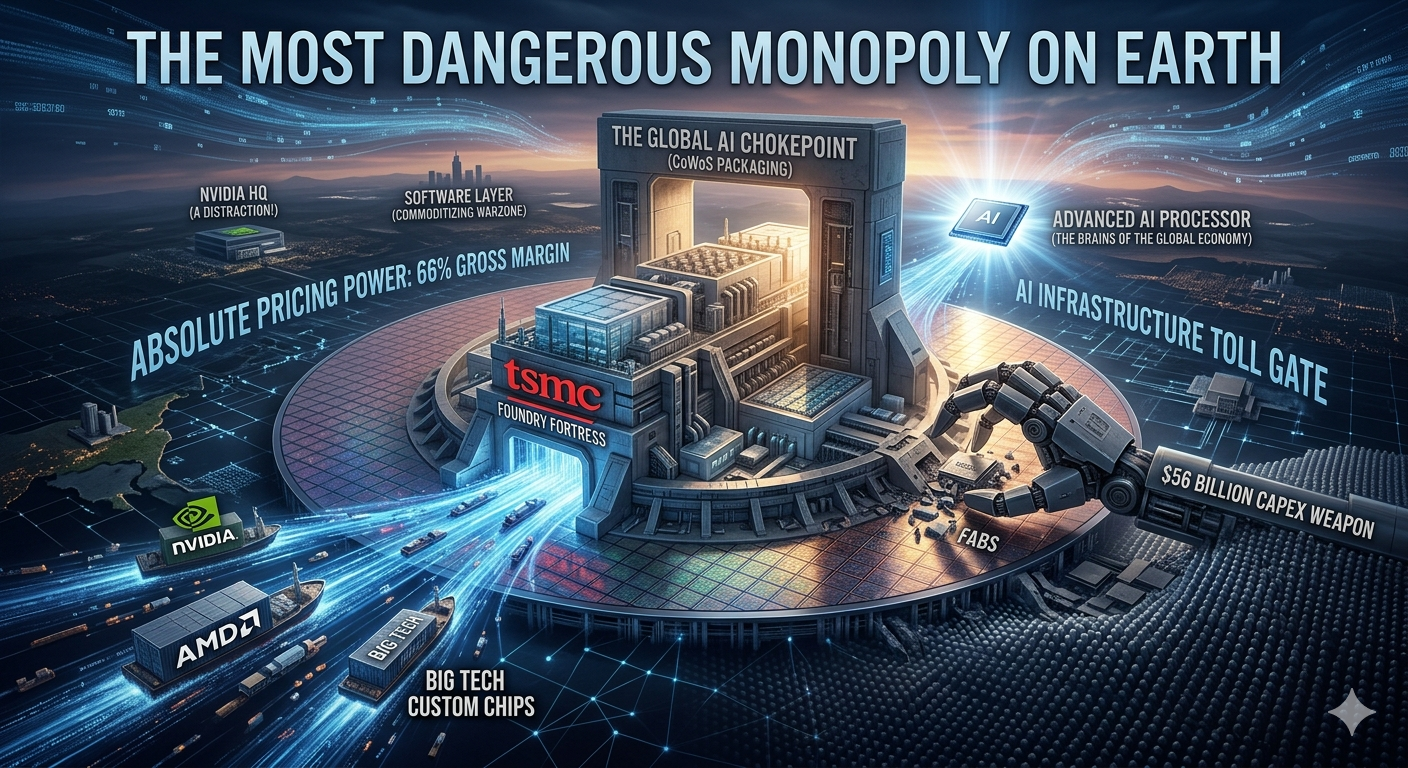
Let’s strip away the hype and look at the terrifying raw data from the late April 2026 earnings print. TSMC reported Q1 revenue of a staggering $35.9 billion—a massive 35.1% year-over-year surge. Their net profit exploded by 58%. But the number that caused institutional investors to aggressively accumulate shares was the Gross Margin: an unbelievable 66.2%. In the brutally capital-intensive, physically constrained world of semiconductor manufacturing, a 66% gross margin is not supposed to be mathematically possible. It signifies absolute, dictatorial pricing power. Furthermore, High-Performance Computing (HPC)—the segment that includes AI chips for Nvidia, AMD, and custom silicon for Google and Amazon—now accounts for over 61% of TSMC’s total revenue mix. The AI transition is complete. TSMC is no longer just making smartphone chips; they are printing the brains of the new global economy.
As a tech investment analyst who monitors global supply chains, the most critical signal from the Q1 report wasn’t the past revenue; it was the forward guidance. TSMC aggressively raised its 2026 Capital Expenditure (CapEx) budget to a mind-bending $52 billion to $56 billion. To put that into perspective, TSMC is spending roughly $150 million every single day on new equipment, advanced packaging facilities (CoWoS), and next-generation 2nm fabs. This is not a defensive move; this is a strategic kill shot. Here is the deep-dive analysis of why TSMC’s 72% monopoly on the foundry market, combined with their $56B CapEx weapon, makes them the ultimate AI investment for 2026 and beyond.
1. The Advanced Packaging Chokepoint: The CoWoS Monopoly
The biggest secret in the AI hardware industry is that the bottleneck isn’t the GPU itself; it’s the packaging. Modern AI chips, like Nvidia’s B200, require incredibly complex ‘Advanced Packaging’ techniques (like TSMC’s proprietary CoWoS – Chip-on-Wafer-on-Substrate) to physically connect the logic processor with the high-bandwidth memory (HBM). Nobody on the planet can perform this packaging at the scale, yield, and precision of TSMC. Even if a competitor designs a faster AI chip, they literally cannot manufacture it without begging TSMC for CoWoS capacity. TSMC knows this, which is why they are aggressively expanding their packaging facilities, cementing a physical chokepoint that gives them absolute leverage over every major tech giant in the world.
2. The $56 Billion CapEx Weapon: Outspending the Competition into Oblivion
In the semiconductor foundry business, the barrier to entry is entirely financial. A single extreme ultraviolet (EUV) lithography machine costs over $300 million, and a modern fab costs over $20 billion to build. By raising their 2026 CapEx to $56 billion, TSMC is intentionally initiating a game of financial Russian roulette that their competitors (Samsung and Intel) cannot survive. TSMC is using the massive cash flow generated by the AI boom to build the 2nm and 1.6nm factories of the future *today*. By the time competitors scrape together the capital to catch up to today’s technology, TSMC will have already moved the goalposts two generations forward. This astronomical CapEx ensures that their 72% market share will not just be maintained; it will expand.
3. The Custom Silicon Tsunami: Big Tech Bypasses Nvidia, But Cannot Bypass TSMC
Nvidia is currently enjoying massive margins, but Google, Amazon, Meta, and Microsoft are tired of paying the \”Nvidia Tax.\” Their solution? Design their own custom AI chips (TPUs, Trainium, MTIA, Maia). This trend terrifies Nvidia investors, but for TSMC, it is a massive tailwind. Whether Google designs the chip or Nvidia designs the chip, they all *must* send the blueprints to TSMC to actually get it manufactured. TSMC is completely agnostic to who wins the AI design war. They are the casino; the house always wins. The explosion of custom silicon means TSMC’s order books are diversified, resilient, and booked solid for the next five years.
Stop trying to guess which AI software will win or which chatbot will be the most popular next month. The software layer is a volatile warzone of rapid commoditization. The hardware layer is a brutally entrenched monopoly. TSMC has achieved absolute technological supremacy, backed it up with insurmountable financial firepower, and locked in the entire global AI infrastructure as a captive customer base. The $35.9 billion Q1 revenue is just the opening act. Buy the foundry, hold the physical bottleneck, and let the AI revolution pay you a toll on every single calculation.
#TSMC #Semiconductors #TechInvesting #ArtificialIntelligence #StockMarket2026 #Nvidia #ValueInvesting #Foundry #CapEx #CoWoS #TechMonopoly #Taiwan
답글 남기기