TL;DR (Summary)
Specialized AI chips, known as Neural Processing Units (NPUs), are rapidly moving from data centers into everyday consumer electronics. This shift to “on-device” or “edge” AI is driven by three key factors: speed (no internet lag), privacy (your data stays on your device), and efficiency (lower power consumption and offline functionality). You’re already using them in your smartphone for enhanced photos and real-time translation. Now, they are appearing in smart speakers, laptops, and even kitchen appliances to enable more responsive, secure, and context-aware features, paving the way for a future of truly ambient computing.
The Invasion of the Tiny Brains
It used to be simple. The CPU was the brain, the GPU handled the pretty pictures. This paradigm held for decades. But look around now. Your new smartphone boasts a “Neural Engine.” Your laptop advertises its built-in “NPU.” Your smart speaker responds instantly, even before the Wi-Fi light blinks. And yes, high-end refrigerators now contain processors dedicated solely to artificial intelligence. This isn’t a gimmick; it’s a fundamental architectural shift in personal technology. The processing power once reserved for massive, cloud-based servers is now being hyper-miniaturized and embedded directly into the devices we use every day. Why? The answer lies in the limitations of the cloud and the demands of modern AI.
From the Cloud to the Countertop: The Edge Revolution
For the last decade, “AI” was synonymous with “the cloud.” Your device was a dumb terminal. You spoke a command, that audio file was sent to a Google or Amazon server, a massive AI model processed it, and the result was sent back. This worked, but it had three glaring weaknesses that on-device AI chips are built to solve:
- Latency: The round trip to a server and back takes time. It might only be milliseconds, but for tasks like real-time video effects, augmented reality, or live language translation, that delay is unacceptable. On-device processing is virtually instantaneous.
- Privacy: This is the big one. Do you really want a recording of every conversation near your smart speaker sent to a third-party server? Or your private photos uploaded for analysis? By keeping the processing local, sensitive data never has to leave your device. The NPU analyzes the data right where it’s created, providing a powerful and marketable privacy guarantee.
- Connectivity & Efficiency: Cloud AI requires a constant, stable internet connection. On-device AI works on an airplane, in a subway, or during an internet outage. Furthermore, sending data back and forth consumes significant battery power and mobile data. A specialized, low-power NPU is dramatically more energy-efficient for AI tasks than a power-hungry CPU or modem.
Anatomy of an AI Chip: CPU vs. GPU vs. NPU
To understand why these new chips are necessary, think of a kitchen. A CPU (Central Processing Unit) is like a master chef. It’s incredibly versatile and can do any task you give it—chopping, boiling, baking—but it can only do one or two things at once. A GPU (Graphics Processing Unit) is like having hundreds of kitchen assistants. They can’t do complex tasks, but they can all chop carrots at the same time, making them perfect for the highly parallel task of rendering graphics.
An NPU (Neural Processing Unit) is different. It’s a hyper-specialized tool, like an industrial-grade apple corer and slicer. It can’t bake a cake or boil water, but it can process apples at a speed and efficiency the master chef could only dream of. In technical terms, NPUs are designed to perform the core math of neural networks—matrix multiplications and vector operations—at an incredible rate with minimal power draw. This specialization is their superpower.
| Metric | Cloud-Based AI | On-Device AI (NPU) |
|---|---|---|
| Latency | High (dependent on network) | Extremely Low (Near-Instant) |
| Privacy | Lower (Data sent to server) | Very High (Data stays on device) |
| Offline Access | None | Fully Functional |
| Power Consumption | High (due to data transmission) | Very Low (Optimized hardware) |
| Model Complexity | Virtually Unlimited | Limited by chip’s memory/power |
The Hardware Arms Race: Measuring in TOPS
The performance of these chips is measured in TOPS (Trillions of Operations Per Second). This metric has become the new benchmark in the silicon arms race. Apple’s A11 Bionic chip in 2017 featured a Neural Engine capable of 0.6 TOPS. Today, flagship smartphone chips from Apple, Qualcomm, and Google boast NPUs capable of over 30 TOPS—a 50x increase in just a few years. This exponential growth in on-device processing power is what enables increasingly sophisticated AI features.
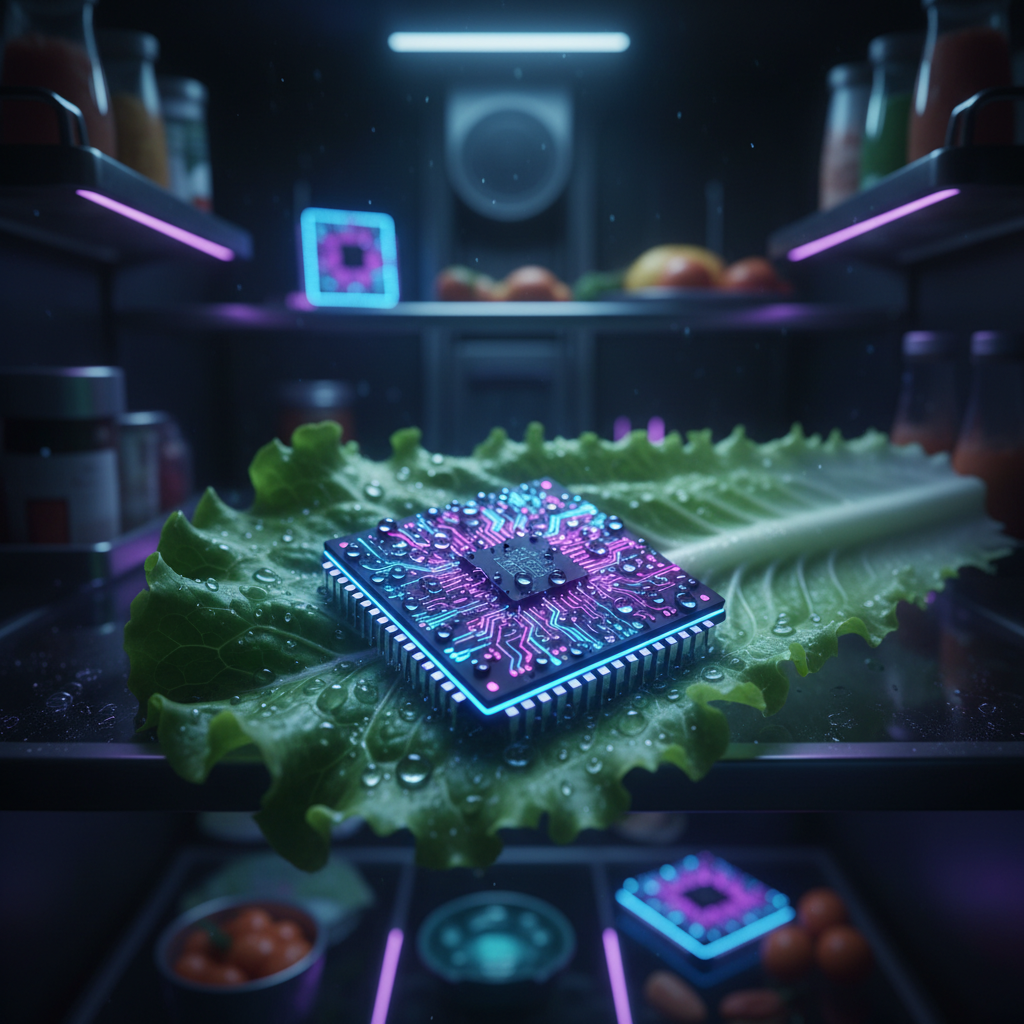
This is where your fridge comes in. It doesn’t need 30 TOPS of performance, but a small, efficient NPU can power a camera that recognizes the milk is low, identifies the vegetables in your crisper, and suggests a recipe without ever sending a single image to a server. Your laptop uses its NPU to blur your background in a video call with perfect efficiency, leaving the CPU and GPU free for other tasks. Your smartwatch NPU can analyze subtle changes in your heart rate and gait to detect potential health issues locally.
The Future is Ambient and On-Device
The integration of AI chips into consumer electronics is not about making individual gadgets “smarter” in a vacuum. It’s the critical foundation for the next paradigm: ambient computing. This is a future where technology fades into the background, anticipating your needs and responding intelligently to your environment without constant manual input. Your home will know when you’re on your way and adjust the temperature. Your devices will seamlessly share context, so you can start a task on your phone and finish it on your laptop without thinking.
This seamless, private, and responsive world is impossible with a cloud-first approach. It requires a distributed network of localized intelligence. These tiny silicon brains, humming away silently in our phones, speakers, and yes, even our refrigerators, are the neurons of that future intelligent environment. They are the reason our technology will finally start to feel less like a collection of tools and more like a true, helpful extension of ourselves.
Leave a Reply