TL;DR (Summary)
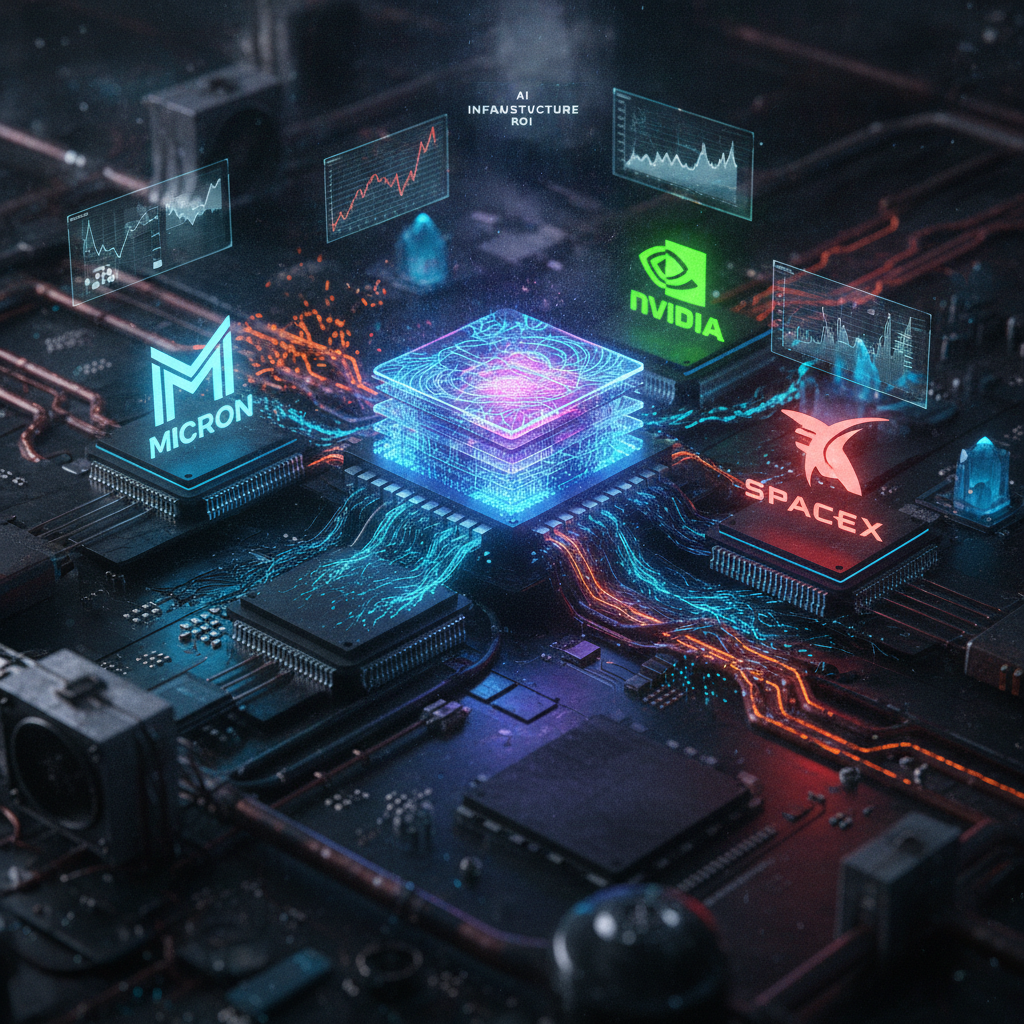
The burgeoning AI infrastructure boom presents a complex investment landscape, dominated by hardware titans and connectivity innovators. This analysis dissects the core contributions of Micron (HBM3E memory), Nvidia (Blackwell GPU architecture), and SpaceX (Starlink global connectivity) to the AI ecosystem. We delve into the technical intricacies of Blackwell’s multi-die GPU design versus HBM3E’s stacked memory architecture, evaluating their synergistic performance implications and the critical bottlenecks they address. From my engineering/infrastructure analysis, the interplay between computational throughput and memory bandwidth is paramount, with HBM3E directly influencing Blackwell’s effective performance. SpaceX’s Starlink, often overlooked in pure hardware discussions, emerges as a pivotal enabler for distributed AI, offering low-latency, high-bandwidth global connectivity that unlocks new deployment paradigms and mitigates data gravity issues, especially for edge AI and real-time inference. Financially, we assess the divergent risk profiles and potential ROIs, considering market saturation, supply chain vulnerabilities, and the long-term sustainability of their competitive advantages. Nvidia’s platform dominance faces increasing competition and potential margin compression, while Micron’s specialized memory finds its niche but is susceptible to cyclical demand. SpaceX, with its vertically integrated space infrastructure, provides a unique long-term play on global data backbone evolution. Ultimately, a balanced portfolio acknowledging these interconnected dependencies is crucial for navigating the AI infrastructure investment wave.
The AI Infrastructure Nexus: A Convergent Analysis
The current technological epoch is unequivocally defined by Artificial Intelligence. Its insatiable demand for computational power, memory bandwidth, and ubiquitous connectivity has forged an entirely new infrastructure paradigm. As an engineer deeply embedded in infrastructure analysis, I find this confluence of hardware innovation and global networking particularly fascinating. We’re not just witnessing incremental improvements; we’re observing foundational shifts in how data is processed, stored, and transmitted, all to fuel increasingly complex AI models. This deep dive aims to dissect the roles of three pivotal players – Micron, Nvidia, and SpaceX – in this grand architectural undertaking, offering a technical and financial comparative analysis that goes beyond surface-level market chatter.
Nvidia’s Blackwell: The Computational Engine’s Evolution
Nvidia’s Blackwell architecture, exemplified by the GB200 Superchip, represents the vanguard of AI computation. At its core, Blackwell is not merely a larger GPU; it’s a fundamental rethinking of how massively parallel processing units are integrated and scaled. The GB200, for instance, pairs two Blackwell GPUs with a Grace CPU, creating a formidable computational node. Critically, each Blackwell GPU itself is a multi-die design, leveraging advanced packaging technologies like CoWoS (Chip-on-Wafer-on-Substrate) to achieve unprecedented transistor counts and processing capabilities. This architectural choice is driven by the limits of reticle size and the desire to maximize yield and performance per silicon area. The interconnectivity within the Blackwell system, particularly the NVLink-C2C (Chip-to-Chip) interface, provides 900 GB/s of bidirectional bandwidth between the GPU dies, effectively making them behave as a single, monolithic chip from a software perspective. This is a crucial engineering feat, addressing the latency and bandwidth challenges inherent in multi-chip modules.
From my engineering perspective, the sheer scale of Blackwell’s FP8 (8-bit floating point) and FP4 capabilities, alongside its Transformer Engine optimizations, directly addresses the growing appetite of Large Language Models (LLMs) and diffusion models. These models thrive on parallel processing and require immense throughput for both training and inference. Blackwell’s performance, projected to be orders of magnitude greater than its predecessors like Hopper (H100) in specific AI workloads, underscores Nvidia’s continued dominance in high-performance computing. However, this dominance comes with an incredible power envelope, necessitating advanced cooling solutions (liquid cooling is becoming standard) and significant data center infrastructure upgrades, directly impacting operational expenditures for AI service providers. According to industry reports from TrendForce, a single Blackwell GB200 Superchip cluster could consume upwards of 1.2 MW, highlighting the escalating energy demands of future AI data centers.
Micron’s HBM3E: The Memory Bandwidth Imperative
While Nvidia provides the computational muscle, Micron delivers the indispensable memory bandwidth that feeds this beast. High Bandwidth Memory (HBM) has become the de facto standard for AI accelerators due to its unparalleled throughput and power efficiency compared to traditional GDDR memory. Micron’s HBM3E (High Bandwidth Memory 3E) is the latest iteration, offering densities up to 24GB per stack and speeds exceeding 9.2 Gb/s per pin, translating to over 1.2 TB/s of aggregate bandwidth per single HBM3E stack. A Blackwell GPU typically integrates multiple HBM3E stacks (e.g., eight stacks for the full GB200 configuration), resulting in an astonishing total memory bandwidth that is absolutely critical for AI workloads.
The technical elegance of HBM3E lies in its 3D stacking architecture. Multiple DRAM dies are stacked vertically on a base logic die, interconnected by Through-Silicon Vias (TSVs). This dense packaging significantly reduces the physical distance data must travel, thereby minimizing latency and power consumption. The ‘E’ in HBM3E signifies ‘Enhanced,’ referring to improvements in both speed and capacity over its HBM3 predecessor. For AI applications, especially those involving massive datasets and complex models, memory bandwidth is often the primary bottleneck, even more so than raw computational FLOPS. If the GPU cores cannot be fed data fast enough, they sit idle, wasting valuable compute cycles and power. Therefore, Micron’s advancements in HBM3E are not merely complementary but fundamentally enabling for architectures like Blackwell. Based on JEDEC standards and Micron’s own technical disclosures, HBM3E represents a critical inflection point in memory technology, directly impacting the practical performance ceiling of next-generation AI accelerators. Investment in Micron, therefore, is a direct bet on the continued necessity of high-bandwidth, low-latency memory as AI models scale.
SpaceX’s Starlink: Global Connectivity for Distributed AI
Often overlooked in the direct hardware battle, SpaceX’s Starlink provides a unique and increasingly critical layer to the AI infrastructure stack: ubiquitous, low-latency global connectivity. While Blackwell and HBM3E solve the intra-data center compute and memory challenges, Starlink addresses the inter-data center and edge-to-cloud connectivity problem. The Starlink constellation, comprising thousands of low Earth orbit (LEO) satellites, offers broadband internet access with typical latencies ranging from 20-40 ms, significantly lower than traditional geostationary satellites and competitive with terrestrial fiber in many remote or underserved areas. For AI, this has profound implications.
Consider the rise of distributed AI training and inference. As models grow, they are increasingly trained across geographically dispersed data centers to optimize resource utilization and leverage diverse datasets. Starlink provides a resilient, high-bandwidth backbone for connecting these distributed nodes, especially in regions where fiber optic infrastructure is nascent or non-existent. Furthermore, the advent of edge AI – where inference occurs closer to the data source (e.g., autonomous vehicles, industrial IoT, smart agriculture) – necessitates robust, low-latency communication back to centralized AI models for updates, retraining, and complex decision-making. Starlink’s direct-to-device capabilities and expanding ground station network offer a compelling solution for these scenarios, mitigating “data gravity” issues where computational resources must be moved closer to data sources due to connectivity limitations. Per an analysis by Morgan Stanley, Starlink’s addressable market extends far beyond consumer broadband into enterprise, maritime, and governmental sectors, all of which increasingly rely on AI-driven operations.
In my technical review, Starlink’s potential extends to enabling real-time AI applications across vast geographies. Imagine an AI-powered drone fleet performing environmental monitoring in remote regions, continuously uploading processed data and receiving updated models via Starlink. Or a global supply chain optimizing logistics with real-time data from sensors in transit, feeding into a centralized AI. The ability to connect anything, anywhere, at speed, fundamentally alters the deployment landscape for AI, unlocking new use cases and revenue streams that were previously constrained by connectivity. This makes SpaceX, through Starlink, not just a connectivity provider but a strategic enabler for the global proliferation and decentralization of AI.
Comparative Financial Analysis and Investment Risks
Investing in the AI infrastructure boom requires a nuanced understanding of each player’s market position, competitive advantages, and inherent risks. Each company operates on different segments of the value chain, with varying levels of integration and exposure to market cycles.
Nvidia: Platform Dominance vs. Competition and Supply Chain
- Strengths: Unrivaled software ecosystem (CUDA, libraries), first-mover advantage, strong brand loyalty, deep R&D investment. Their platform approach creates high switching costs.
- Risks: Increasing competition from custom ASICs (Google TPUs, Amazon Inferentia), AMD’s MI series, and startups. Dependence on TSMC for advanced manufacturing nodes introduces supply chain vulnerability. High valuation makes it susceptible to market corrections. Potential for margin compression as AI hardware becomes more commoditized over time. According to Bloomberg consensus data, Nvidia’s forward P/E ratios remain significantly higher than the semiconductor industry average, reflecting high growth expectations.
- ROI Outlook: Strong near-term growth driven by AI adoption. Long-term depends on maintaining software ecosystem lock-in and fending off competitors. Diversification into enterprise software and services could provide additional revenue streams.
Micron: Specialized Memory Niche vs. Cyclicality
- Strengths: Leadership in HBM3E and other advanced memory technologies. Critical component for high-performance AI. Diversified product portfolio beyond HBM.
- Risks: Semiconductor memory industry is notoriously cyclical, subject to boom-and-bust cycles driven by supply/demand imbalances. High capital expenditure requirements for manufacturing. Intense competition from Samsung and SK Hynix. Margins can be volatile. Micron’s Q4 2023 earnings report highlighted a return to profitability, but also underscored the historical volatility of DRAM and NAND markets.
- ROI Outlook: Direct beneficiary of AI hardware proliferation. HBM’s specialized nature offers some insulation from general memory market downturns, but overall semiconductor cycles will still impact performance. Long-term growth tied to continued advancements in memory technology and increasing memory content per device.
SpaceX (Starlink): Connectivity Enabler vs. Capital Intensity and Regulation
- Strengths: Vertically integrated (launch, satellites, ground segment). First-mover advantage in LEO broadband. Unique capability for global, low-latency connectivity. Diversified revenue streams (launch services, Starlink subscriptions).
- Risks: Extremely capital-intensive business model (manufacturing and launching thousands of satellites). Regulatory hurdles in various countries. Competition from other LEO constellations (Amazon Kuiper, OneWeb). Susceptible to space debris and geopolitical risks. Starlink’s profitability is still emerging, with significant upfront investment costs.
- ROI Outlook: Long-term play on global digital inclusion and distributed AI. High growth potential in enterprise, government, and underserved markets. Success hinges on continued execution, cost reduction per satellite, and expanding market penetration. A 2023 report by Euroconsult projected the LEO satellite market to reach over $100 billion by 2030, indicating significant growth potential for Starlink.
Synergistic Dependencies and Future Outlook
The true power of the AI infrastructure boom lies not in any single component, but in the synergistic dependencies among them. Blackwell needs HBM3E to perform optimally; without sufficient memory bandwidth, its immense computational power would be underutilized. And without robust global connectivity like Starlink, the ability to deploy, train, and infer AI models across diverse geographies and edge environments would be severely hampered. These companies, while seemingly disparate, are deeply intertwined in the grand tapestry of AI enablement.
Looking ahead, the evolution of AI hardware will likely see continued integration – perhaps even more tightly coupled compute and memory. We might see novel cooling solutions become standard, pushing data center design to its limits. On the connectivity front, advancements in optical inter-satellite links and direct-to-cell capabilities for LEO constellations will further enhance Starlink’s value proposition. The demand for AI will only intensify, driven by advancements in areas like multimodal AI, robotics, and scientific discovery, ensuring that the foundational infrastructure provided by these titans remains critical. According to Federal Reserve projections on technology sector growth, AI-related infrastructure spending is expected to outpace general IT spending for the foreseeable future, suggesting a sustained tailwind for these companies.
Conclusion: A Strategic Investment Perspective
For investors, a strategic approach acknowledges these interdependencies. A balanced portfolio might consider exposure to all three layers: the computational engine (Nvidia), the memory backbone (Micron), and the global nervous system (SpaceX/Starlink). While Nvidia offers high growth and market dominance, it also carries a premium valuation and faces increasing competition. Micron provides a crucial, specialized component, albeit within a cyclical industry. SpaceX, through Starlink, offers a long-term, high-potential play on global connectivity and decentralized AI, albeit with significant capital requirements and execution risk. Understanding the technical merits, market positioning, and financial profiles of each is paramount to navigating this complex, yet incredibly rewarding, investment landscape.
| Company | Primary Contribution to AI | Key Technical Innovation | Market Position | Primary Investment Risk | 2023 Revenue (Approx.) |
|---|---|---|---|---|---|
| Nvidia | Computational Engine (GPUs) | Blackwell Multi-die GPU, NVLink-C2C, CUDA | Dominant (90%+ AI GPU market share) | Competition, Supply Chain, Valuation | $60.9 Billion |
| Micron | High-Bandwidth Memory (HBM) | HBM3E 3D Stacking, TSV Interconnects | Top 3 (HBM market) | Memory Cyclicality, Intense Competition | $15.5 Billion |
| SpaceX (Starlink) | Global Connectivity | LEO Satellite Constellation, Phased Array Antennas | Leader (LEO Broadband) | Capital Intensity, Regulation, Competition | $9 Billion (Estimated for SpaceX total) |
Leave a Reply