[image1]
Every time you ask ChatGPT a complex question, generate an image, or summarize a document, your request travels hundreds of miles to a massive, energy-devouring data center. There, arrays of incredibly expensive GPUs process your prompt, calculate the probabilities, and beam the answer back to your device. This cloud-centric model of Artificial Intelligence is powerful, but as an engineer analyzing the infrastructure, I can tell you it is fundamentally unsustainable. We are hitting a wall regarding latency, privacy, and most importantly, inference costs. The cloud is choking.
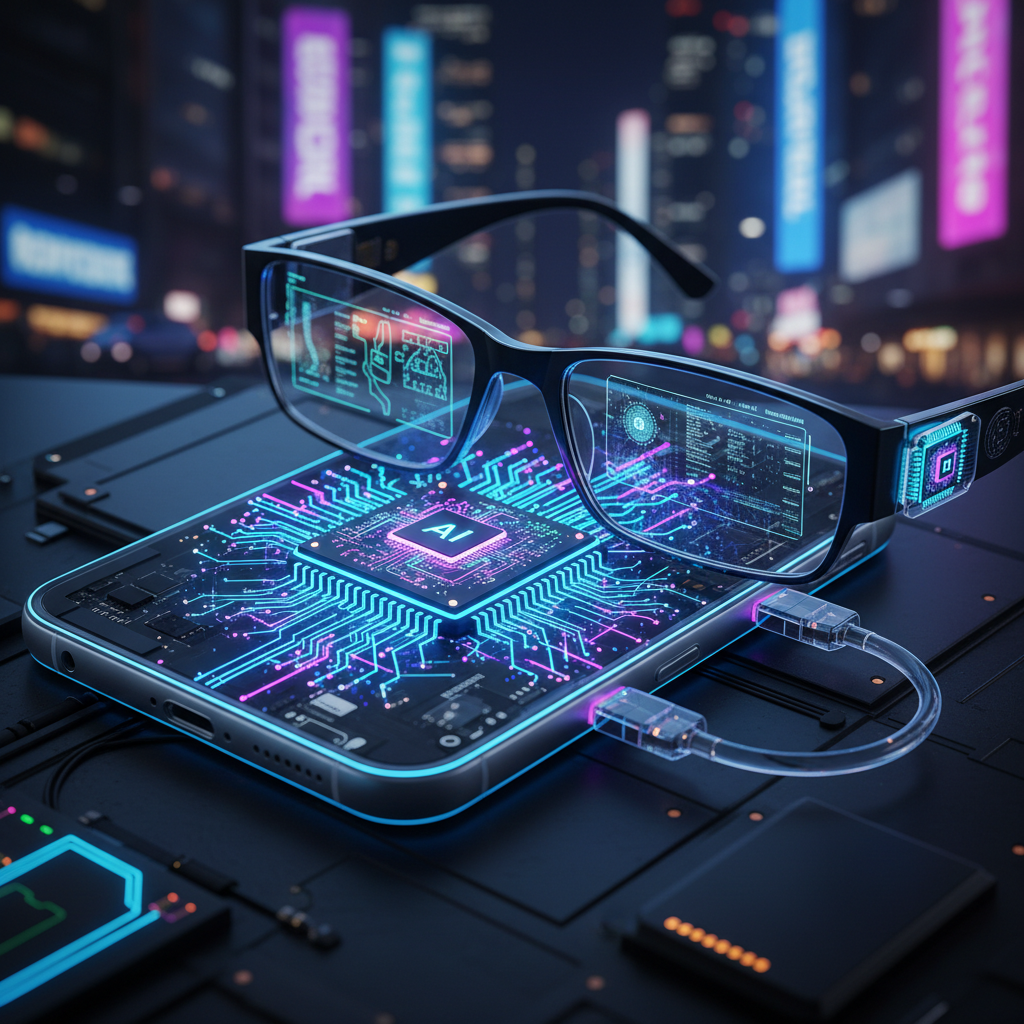
A recent Stanford AI Index Report highlighted the terrifying explosion in AI inference costs. Companies are realizing that training an LLM is a one-time capital expenditure, but running it for millions of users is an infinite operational hemorrhage. The paradigm is violently shifting. We are moving away from centralized server farms and driving the intelligence directly into the hardware in your pocket and on your desk. Welcome to the era of “Edge AI.” According to Gartner’s latest 2026 Semiconductor Forecast, the Edge AI market is exploding into a $500 Billion industry. The true AI war is no longer just about massive data centers; it is a brutal, high-stakes battle for dominance in On-Device AI chips, specifically Neural Processing Units (NPUs).
Why is Edge AI inevitable? First, absolute zero latency. When a self-driving car needs to detect a pedestrian, or a medical device needs to flag an anomaly, waiting 200 milliseconds for a cloud server ping is a matter of life and death. Local execution is instantaneous. Second, absolute privacy. Your biometric data, financial documents, and personal conversations never leave your local silicon. Third, cost destruction. Running a local 8-billion parameter LLM costs the software provider exactly zero dollars in server compute.
This tectonic shift from the Cloud to the Edge has triggered a massive hardware race. If you are looking at the foundational architecture of 2026, these are the three companies positioned to ruthlessly dominate the On-Device Chip War.
1. Qualcomm: The Snapdragon Ascendancy
For years, Qualcomm dominated mobile communications, but they have aggressively pivoted to become the king of Edge AI compute. With the release of their Snapdragon X Elite series for PCs and the advanced Gen 4 platforms for mobile, they aren’t just improving CPU speeds; they are heavily over-indexing on NPU performance. Qualcomm’s architecture currently delivers some of the highest TOPS (Tera Operations Per Second) per watt in the industry. By deeply integrating their Hexagon NPU with standard processing cores, they are empowering developers to run complex, multi-modal generative AI tasks locally on ultra-thin laptops and smartphones without draining the battery in an hour. They are the primary engine driving the “AI PC” revolution for the Windows ecosystem.
2. ARM Holdings: The Architectural Monopoly
ARM does not fabricate chips; they design the fundamental instruction sets that almost everyone else (including Apple and Qualcomm) relies upon. ARM is the bedrock of mobile computing, holding a near 99% market share in smartphone architectures. Their latest v9 architecture, specifically featuring the Scalable Matrix Extension (SME), is a masterclass in Edge AI design. SME allows standard ARM cores to perform the heavy matrix math required for neural networks natively and efficiently. As the world transitions to On-Device AI, almost every piece of silicon executing those local LLMs is paying a licensing fee to ARM. They are the ultimate tollbooth in the Edge AI explosion.
3. Apple: The Unified Memory Masterclass
Apple recognized the Edge AI requirement years before the term became a buzzword. While the rest of the industry was scrambling to attach discrete NPUs to their motherboards, Apple perfected the Unified Memory Architecture (UMA) with their Apple Silicon (M-series and A-series). This is their absolute killer advantage. Running local AI models requires massive amounts of high-bandwidth memory. In a standard PC, data must awkwardly shuffle between system RAM and the GPU. In an M4 or M5 Mac, the CPU, GPU, and Neural Engine all share the same massive pool of blazing-fast memory. This allows a standard MacBook Pro to load and execute massive 30-billion parameter open-source LLMs locally—a feat that would require thousands of dollars of discrete hardware on a traditional PC setup.
The era of treating our devices as dumb terminals connecting to smart clouds is over. The intelligence is migrating to the edge. The $500 billion wealth transfer in the semiconductor industry is accelerating, and the companies architecting the local NPU revolution are the ones building the true infrastructure of tomorrow.
#EdgeAI #NPU #Semiconductors #AppleSilicon #Qualcomm #ARMHoldings #ArtificialIntelligence #TechInvesting #FutureOfTech #OnDeviceAI
Leave a Reply