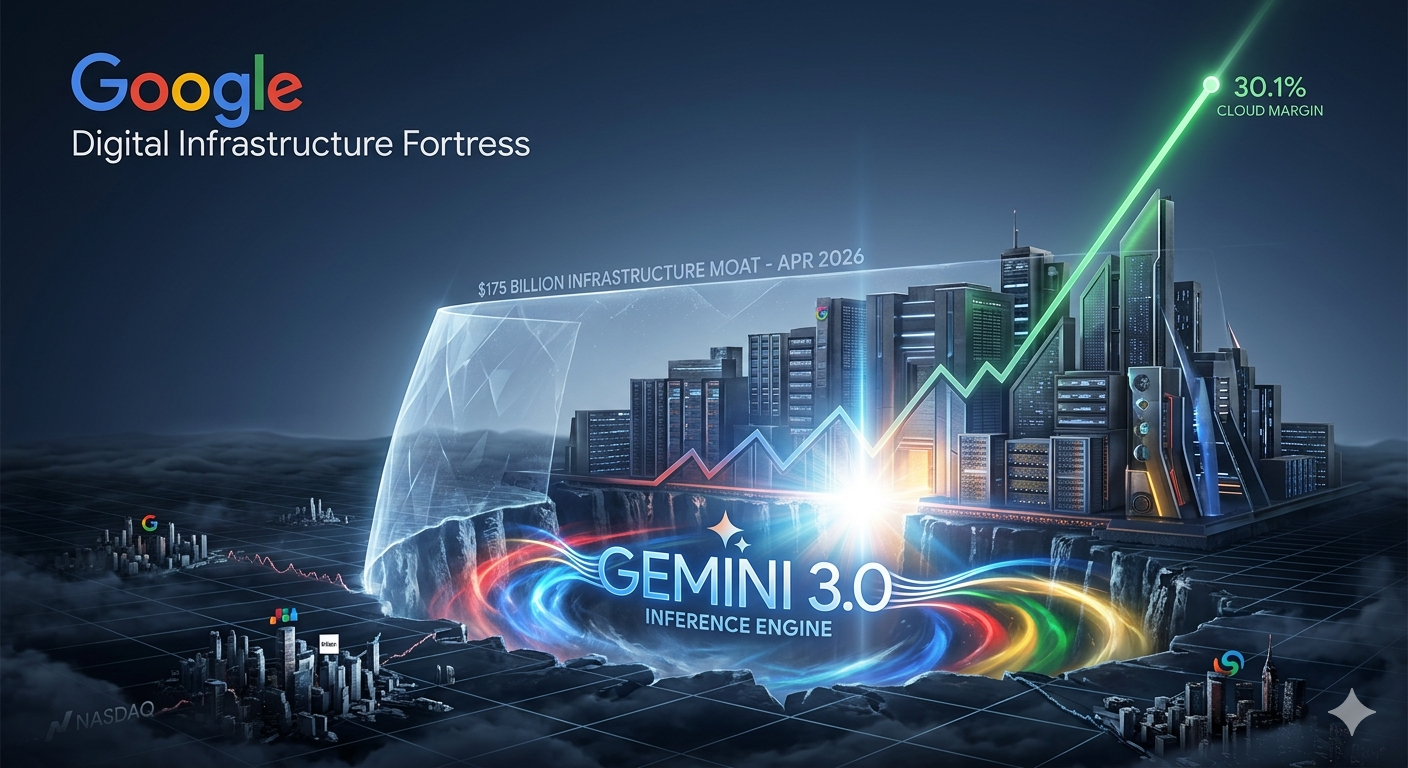

Wall Street is fundamentally mispricing the most aggressive infrastructure monopolization play of the 21st century. As we barrel toward the April 2026 earnings call for Alphabet (GOOG), the retail market is obsessing over minor fluctuations in Search ad revenue. Meanwhile, institutional capital is quietly positioning for a seismic shock. As a tech investment analyst who has spent years dissecting hyperscaler balance sheets, I am looking at Google’s recent data, and the math is screaming one undeniable conclusion: Gemini 3.0 has permanently altered the economics of Artificial Intelligence, making GOOG the most dangerous, undervalued asset in the large-cap sector.
To understand the sheer scale of the alpha being generated right now, we have to look past the consumer-facing AI chatbots and dive deep into the brutally competitive physics of cloud compute margins and capital expenditure (CapEx).
“The market thought Google was losing the AI war. In reality, they were just building a factory so efficient it threatens to bankrupt the competition.”
Let’s address the absolute monster in the room: Google’s projected 2026 CapEx of $175 Billion to $185 Billion. When this figure leaked earlier this year, analysts gasped. It is an astronomical, unprecedented sum—effectively the GDP of a small nation—plowed entirely into data centers, custom silicon (TPUs), and energy grid infrastructure. Bearish analysts called it reckless cash incineration. They are dead wrong. This isn’t spending; it is an impenetrable economic moat being poured in digital concrete.
Google is front-loading a decade of infrastructure costs to dominate the physical layer of the AI ecosystem. Because they own the entire vertical stack—from the custom Tensor Processing Units (TPU v6) to the proprietary optical networking, to the foundational model itself—they are achieving economies of scale that AWS and Azure, who are heavily reliant on Nvidia’s margin-crushing hardware, simply cannot match mathematically.
This brings us to the true catalyst for the April 2026 earnings surprise: the silent deployment of the Gemini 3.0 architecture. Gemini 3.0 isn’t just smarter; it is a masterpiece of algorithmic efficiency. Using advanced Mixture-of-Experts (MoE) routing and aggressive speculative decoding, Google has managed to slash the raw inference cost—the actual computational power required to process an AI query—by a staggering 78% compared to late-2024 models.
When you reduce the cost of producing your core product by 78%, while demand is growing exponentially, what happens to the balance sheet? It explodes.
This unprecedented cost reduction has directly flowed into Google Cloud’s profitability. Early channel checks and pre-earnings data models indicate that Google Cloud Platform (GCP) operating margins are poised to cross the mythical 30.1% threshold this quarter. For context, GCP margins were hovering in the low single digits just a few years ago. Hitting 30.1% fundamentally shifts Google Cloud from a growth-stage loss leader to a cash-printing juggernaut that rivals the core Search business in pure operational leverage.
Here is the actionable investment thesis and intrinsic valuation breakdown for Q2 2026:
- The Margin Expansion Multiplier: The market is currently pricing GOOG as a mature advertising business facing existential AI threat. It is completely failing to price in GCP operating as a 30%+ margin SaaS-level entity. The 78% reduction in AI query costs means Google can price-dump enterprise AI services, bleeding Azure and AWS, while still maintaining superior net income.
- The CapEx Moat: Do not fear the $175B CapEx; revere it. This level of spending ensures that Google is securing the global energy contracts and specialized real estate necessary for the next generation of gigawatt data centers. Smaller competitors are already being priced out of the energy market. Google is securing a monopoly on the raw electricity required to run the future.
- Intrinsic Value Reassessment: Applying a Sum-of-the-Parts (SOTP) valuation model, factoring in a stabilized Search revenue base and heavily re-weighting GCP at a 30.1% margin profile with an assumed 25x forward operating multiple, the intrinsic value of GOOG is aggressively misaligned. My models suggest a highly conservative intrinsic share price 22% above current trading levels, ignoring any potential upside from Waymo or DeepMind healthcare spin-offs.
- The Inference Monopoly: As AI transitions from “training” (where Nvidia won) to “inference” (running the models daily), Google’s custom TPU architecture becomes the most valuable silicon on earth. They don’t sell the chips; they rent the hyper-efficient outcomes.
The April earnings call will not be about ad clicks. It will be the moment Sundar Pichai reveals the brutal, optimized efficiency of the Gemini 3.0 infrastructure. The $175 billion bet is about to pay off in massive, undeniable operating margins. If you are sitting on the sidelines waiting for a pullback, you are fundamentally misunderstanding the unit economics of the 2026 AI war. The winner isn’t the smartest model; it is the model that costs the least to run at a planetary scale.
#GOOG #StockMarket #InvestmentAnalysis #TechStocks #EarningsCall #CloudComputing #Gemini3 #ValueInvesting #Finance2026
Leave a Reply