TL;DR (Summary)
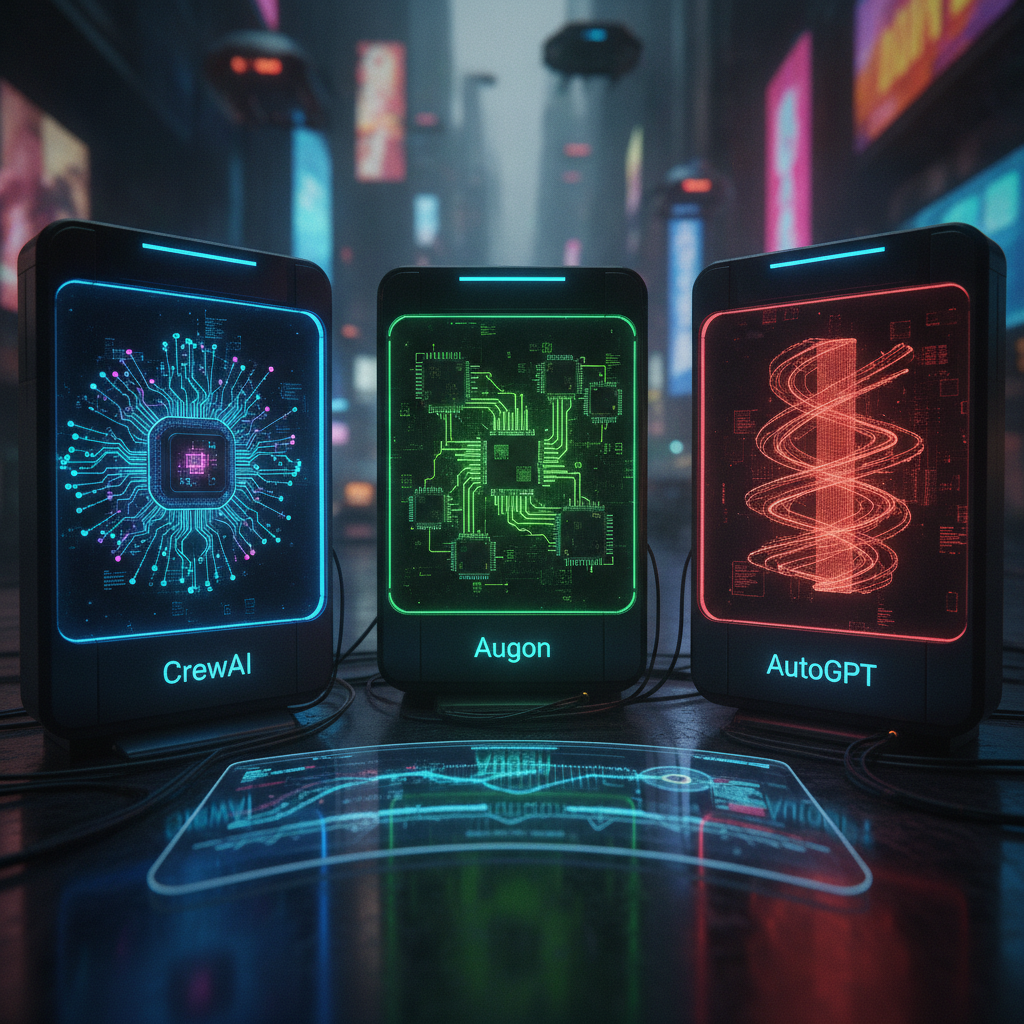
In 2026, AI Agent Frameworks like CrewAI, AutoGen, and AutoGPT have evolved significantly. CrewAI excels in structured, goal-oriented multi-agent workflows with defined roles, making it ideal for solo developers and small teams needing predictable outcomes. AutoGen offers unparalleled flexibility for complex, asynchronous agent conversations, best suited for research and enterprise-level dynamic problem-solving. AutoGPT, while foundational, has matured into a robust platform for autonomous, iterative task execution, often integrated into larger systems. The choice hinges on project complexity, desired collaboration patterns, and scaling needs, with CrewAI for clarity, AutoGen for adaptability, and AutoGPT for autonomous execution.
Navigating the 2026 AI Agent Landscape: A Deep Dive into Multi-Agent Collaboration Frameworks
The year 2026 marks a pivotal moment in the evolution of artificial intelligence. Beyond mere chatbots and single-task automation, the frontier is now dominated by AI Agent Frameworks capable of orchestrating sophisticated multi-agent collaboration. These frameworks empower developers to build systems where autonomous agents interact, delegate, and collectively solve problems far exceeding the capabilities of any single AI. For solo developers and enterprise architects alike, understanding the nuances of leading platforms like CrewAI, AutoGen, and the matured AutoGPT is paramount. This comprehensive comparison will dissect their core strengths, collaboration paradigms, and suitability across various scales.
The Evolution of AI Agents: From Monolithic to Collaborative Intelligence
Just a few years ago, the concept of a truly autonomous AI agent capable of complex, multi-step reasoning was nascent. Fast forward to 2026, and these frameworks leverage advanced Large Language Models (LLMs), sophisticated planning algorithms, and robust communication protocols to enable agents to form “teams.” This shift from isolated intelligence to collaborative problem-solving is driving innovation across every sector, from automated software development to intricate scientific research. The key differentiators now lie in how effectively these frameworks facilitate agent interaction, manage dependencies, and scale for real-world applications.
CrewAI: Structured Harmony for Predictable Outcomes
CrewAI, by 2026, has solidified its position as the go-to framework for developers seeking structured, role-based multi-agent collaboration. Its strength lies in its explicit definition of agents, each with a clear role, goal, and assigned tools. This architectural clarity makes CrewAI remarkably intuitive for solo developers or small teams aiming to build predictable, workflow-driven AI applications.
The core philosophy of CrewAI revolves around a “crew” of agents working towards a common objective, orchestrated by a central process. Agents communicate through a shared blackboard or explicit message passing, often guided by a hierarchical structure. This makes it exceptionally well-suited for tasks requiring sequential execution or well-defined stages, such as automated content generation, market research analysis, or even complex code refactoring.
Key Strengths for Solo Developers:
- Clear Role Definition: Easy to assign specific responsibilities (e.g., “Researcher,” “Writer,” “Editor”).
- Intuitive Workflow Orchestration: Simplifies the design of multi-step processes.
- High Predictability: Given well-defined roles and tasks, outcomes are generally consistent.
- Focused Tool Integration: Agents are equipped with specific tools relevant to their role, minimizing cognitive overload.
While CrewAI can scale horizontally by adding more agents or crews, its strength remains in scenarios where the collaboration pattern is relatively static and known beforehand. For enterprises, it’s excellent for automating specific departmental workflows where roles are clearly delineated.
AutoGen: Dynamic Conversations and Unbounded Flexibility
In stark contrast to CrewAI’s structured approach, AutoGen, maintained by Microsoft Research, has matured into the powerhouse for dynamic, conversational multi-agent systems. AutoGen’s philosophy emphasizes flexible, asynchronous communication where agents can initiate conversations, provide feedback, and even self-correct their interactions without a rigid, predefined script. This makes it an ideal choice for research, exploratory problem-solving, and applications where the solution path is not entirely known upfront.
AutoGen’s architecture allows for complex “agent chats” where agents can take on different personas (e.g., “user proxy agent,” “assistant agent”), providing unparalleled adaptability. Its ability to create custom agents that can interact in arbitrary ways unlocks scenarios like autonomous scientific hypothesis testing, complex system debugging, or even multi-faceted strategic planning where agents need to negotiate and adapt in real-time.
Key Strengths for Enterprise Scale & Research:
- Unmatched Flexibility: Agents can engage in highly dynamic, multi-turn conversations.
- Asynchronous Communication: Enables parallel processing and complex interaction patterns.
- Customizable Agent Behavior: Developers have deep control over agent logic and interaction rules.
- Robust for Complex Problem Solving: Thrives in environments where the solution requires iterative refinement and negotiation between diverse intelligent entities.
For enterprises, AutoGen is invaluable for building foundational AI layers that can adapt to evolving business requirements or tackle problems requiring nuanced, human-like reasoning across multiple domains. Its learning curve can be steeper for solo developers due to its open-ended nature, but the power it offers is unparalleled for those willing to master it.
AutoGPT: The Autonomous Execution Engine, Refined
AutoGPT, while perhaps the earliest to capture public imagination, has evolved significantly by 2026. No longer just a viral sensation, it has matured into a robust, foundational framework for autonomous, iterative task execution. Its strength lies in its ability to set a high-level goal and then autonomously break it down into sub-tasks, execute them, and learn from the outcomes to refine its approach.
Modern AutoGPT implementations integrate seamlessly with various LLMs and leverage sophisticated planning components to manage its internal “thought” process, memory, and tool usage. While it might not offer the same explicit multi-agent collaboration paradigms as CrewAI or AutoGen out-of-the-box, it’s often used as a powerful, single-minded autonomous agent that can be orchestrated within larger systems. For instance, an AutoGPT instance might be one “tool” or “expert” within an AutoGen conversation, or a “task executor” within a CrewAI workflow.
Key Strengths for Autonomous Operations:
- Goal-Oriented Autonomy: Excels at achieving high-level objectives with minimal human intervention.
- Iterative Task Execution: Capable of self-correction and adapting its plan based on results.
- Powerful Tool Integration: Can leverage a wide array of external tools and APIs.
- Foundational for Complex Agents: Often serves as the core reasoning engine for more specialized agents.
For solo developers, AutoGPT is excellent for automating personal productivity tasks or creating “set-and-forget” agents. For enterprises, it’s often embedded into larger systems to handle specific, highly autonomous components, such as automated data pipeline management or continuous integration/deployment assistants.
Comparative Analysis: Suitability Across Scales
Choosing the right framework in 2026 depends heavily on your project’s specific needs, the complexity of agent interactions, and your scaling requirements. The table below summarizes key differentiators:
| Feature | CrewAI (2026) | AutoGen (2026) | AutoGPT (2026) |
|---|---|---|---|
| Collaboration Paradigm | Structured, Role-Based Workflows | Dynamic, Conversational Chats | Autonomous, Iterative Execution |
| Best For | Predictable workflows, content generation, market analysis, solo devs | Research, complex problem-solving, dynamic negotiation, enterprise R&D | Goal-oriented automation, self-correcting tasks, embedding into larger systems |
| Interaction Style | Sequential, hierarchical task delegation | Asynchronous, peer-to-peer discussions | Internal “thought” process, external tool interaction |
| Learning Curve | Low-Moderate (for structured tasks) | Moderate-High (due to flexibility) | Moderate (for goal definition & error handling) |
| Scalability | Horizontal scaling of crews/agents for distinct workflows | Excellent for large-scale, distributed agent networks | Scales well for individual autonomous tasks; can be integrated into larger orchestration |
| Primary Use Case | Automated content pipelines, expert systems | AI-driven scientific discovery, complex software engineering tasks | Automated personal assistants, continuous deployment agents |
The Synergy of Frameworks: Beyond Either/Or
It’s crucial to recognize that by 2026, these frameworks are not mutually exclusive. Many advanced AI solutions leverage the strengths of each. Imagine an enterprise system where:
- A CrewAI team handles structured reporting and content generation, feeding insights.
- An AutoGen ensemble of agents then takes these insights, engages in dynamic discussions, and strategizes on new product features, potentially calling upon an AutoGPT instance as a “consultant” to autonomously explore technical feasibility or generate initial code snippets.
This hybrid approach represents the cutting edge of AI agent development, allowing for both the predictability of structured workflows and the adaptability of dynamic, intelligent conversations.
Conclusion: Charting Your Course in 2026
The landscape of AI Agent Frameworks in 2026 offers incredible power and flexibility. For the solo developer seeking to automate specific, well-defined processes, CrewAI provides a clear and efficient path. For enterprises or researchers tackling highly complex, dynamic problems where agent interactions need to be fluid and adaptive, AutoGen stands out. And for those requiring a robust, autonomous execution engine capable of breaking down and achieving high-level goals, the refined AutoGPT remains a vital tool, often serving as a powerful component within larger systems.
Understanding these distinctions is not just about choosing a tool; it’s about choosing an architectural philosophy that aligns with your project’s inherent complexity and desired collaboration patterns. The future of AI is collaborative, and mastering these frameworks is the key to unlocking its full potential. The journey to building truly intelligent, autonomous systems starts with making the informed choice today.
Leave a Reply