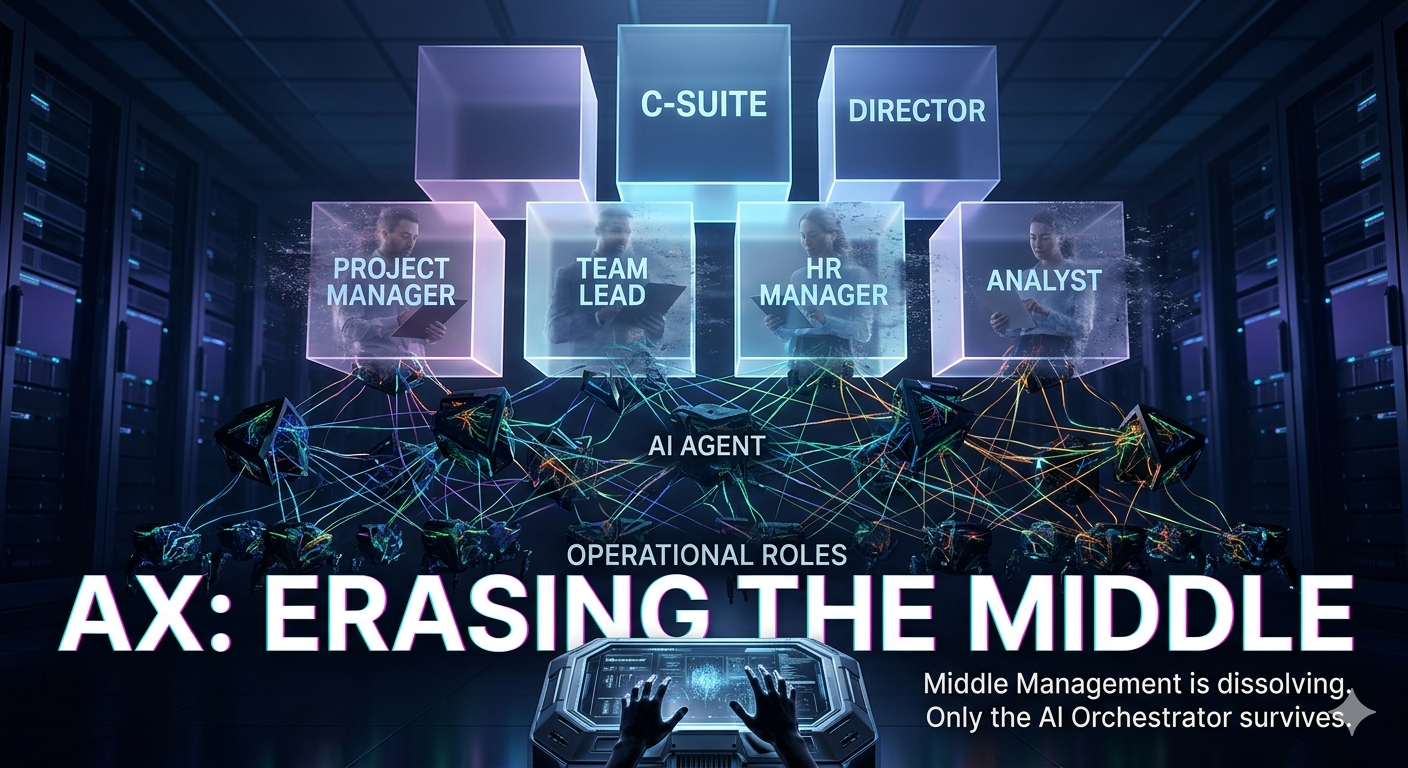

You probably think your corporate job is safe. You sit in your air-conditioned office, creating pivot tables, drafting marketing briefs, and attending endless strategy meetings, convinced that your \”human intuition\” cannot be replicated by code. You might even find comfort in the recent surge of tech executives preaching about \”Responsible AI\”—the idea that artificial intelligence will be heavily regulated, safely contained, and used only to *assist* humans, never to replace them. You believe the regulatory red tape will protect your paycheck. Wake up. The recent visit of Google DeepMind CEO Demis Hassabis to Seoul in April 2026, and his fervent discussions on ‘Responsible AI,’ completely shattered this comforting illusion. While the media focused on the ethical buzzwords, the underlying message to the enterprise world was brutally clear: The AI is no longer a tool; it is a fully autonomous workforce. And ‘Responsible AI’ isn’t about saving your job; it’s about ensuring the AI doesn’t crash the company after it replaces you.
The conversation around AI has fundamentally shifted in 2026. We are no longer talking about LLMs that generate cute poems or help you write an email faster. We have entered the era of ‘Agentic Workflows’ (AX)—systems where AI agents can independently reason, plan multi-step actions, control software, and execute complex business processes without human intervention. During his keynote, Hassabis emphasized that building \”Responsible AI\” now means creating agents that have robust safety constraints so they can be trusted to run mission-critical corporate infrastructure *autonomously*. A chilling Q1 2026 report by the World Economic Forum on the ‘Future of the White-Collar Workforce’ estimated that within the next 36 months, 38% of all administrative, mid-level management, and data-processing roles will be completely eradicated and replaced by AI agent orchestrators. The CEO’s message of ‘safety’ was actually a green light for corporations: The AI is finally reliable enough to fire your human staff.
As a tech analyst who consults on enterprise automation, I have seen exactly what happens when a company adopts these \”responsible\” AX systems. I watched a mid-sized logistics firm deploy a specialized AI agent to handle their entire supply chain procurement. The agent analyzed inventory levels, negotiated pricing with vendors via automated emails, drafted the contracts, and executed the payments. It didn’t need a break, it didn’t ask for a raise, and thanks to the new ‘responsible’ safety rails, it never made a compliance error. The 12-person procurement team was reduced to a single human \”AI Supervisor.\” If you are a white-collar worker, you are standing on the tracks, and the autonomous AI train is coming at full speed. Here is the brutal reality of how Enterprise AI Innovation (AX) will reshape your workplace, and the only strategy you can use to survive the purge.
1. The Shift from ‘Creator’ to ‘Reviewer’
In the past, your value to a company was tied to your ability to create a raw output—writing the code, designing the graphic, or drafting the legal brief. In 2026, the AI agents create the output infinitely faster and generally better than you can. Your role is being forcibly downgraded from a \”Creator\” to a \”Reviewer.\” The AI generates the 50-page financial analysis; your only job is to spend 10 minutes checking it for edge-case hallucinations before presenting it to the board. However, a company does not need 10 human reviewers to check the work of an AI that generates reports instantly. They need exactly one. If your entire skill set is based on producing raw digital output, your economic value has already plummeted to zero.
2. The Rise of the ‘AI Orchestrator’ Role
The only secure jobs left in the corporate hierarchy are the \”AI Orchestrators.\” These are the highly skilled individuals who understand the specific business domain (e.g., healthcare compliance, financial regulations) and know exactly how to deploy, string together, and manage fleets of specialized AI agents. They act as the managers of the robot workforce. They don’t write the marketing copy; they build the automated pipeline that tells Agent A to scrape market trends, Agent B to write the copy, and Agent C to A/B test the ads. To survive, you must desperately pivot from doing the work yourself to building the automated systems that *do* the work. You must learn the basics of agentic frameworks and become the person who controls the machines, not the person competing against them.
3. The Premium on Extreme Human Empathy and Physicality
As cognitive and administrative tasks become fully automated and cost practically nothing, the economic value of traits that an AI absolutely cannot replicate will skyrocket. ‘Responsible AI’ can analyze a legal contract perfectly, but it cannot sit in a room with a terrified client and build genuine trust and emotional rapport. It cannot manage the complex, physical logistics of a chaotic construction site. Jobs that require high-stakes human negotiation, profound emotional intelligence, complex physical dexterity, or the building of deep interpersonal networks will see a massive surge in compensation. If your job can be done entirely through a screen and a keyboard, it will be automated. You must either move up to manage the AI or move out into the messy, physical, human-centric world.
Stop listening to the corporate PR spin. When tech billionaires talk about \”Responsible AI,\” they are not talking about protecting your livelihood; they are assuring their enterprise clients that the autonomous software they are selling won’t hallucinate and cause a lawsuit. The automation of the white-collar class is not a future possibility; it is a current, aggressive reality. Your degree and your years of experience typing on a keyboard will not save you. You must adapt immediately. Stop doing the work. Start building the systems that do the work, or prepare to be permanently logged out.
#FutureOfWork #AgenticAI #ResponsibleAI #DeepMind #JobAutomation #WhiteCollarJobs #TechTrends2026 #CareerSurvival #AIOrchestrator #CorporateTech #ArtificialIntelligence #EconomicShift
Leave a Reply