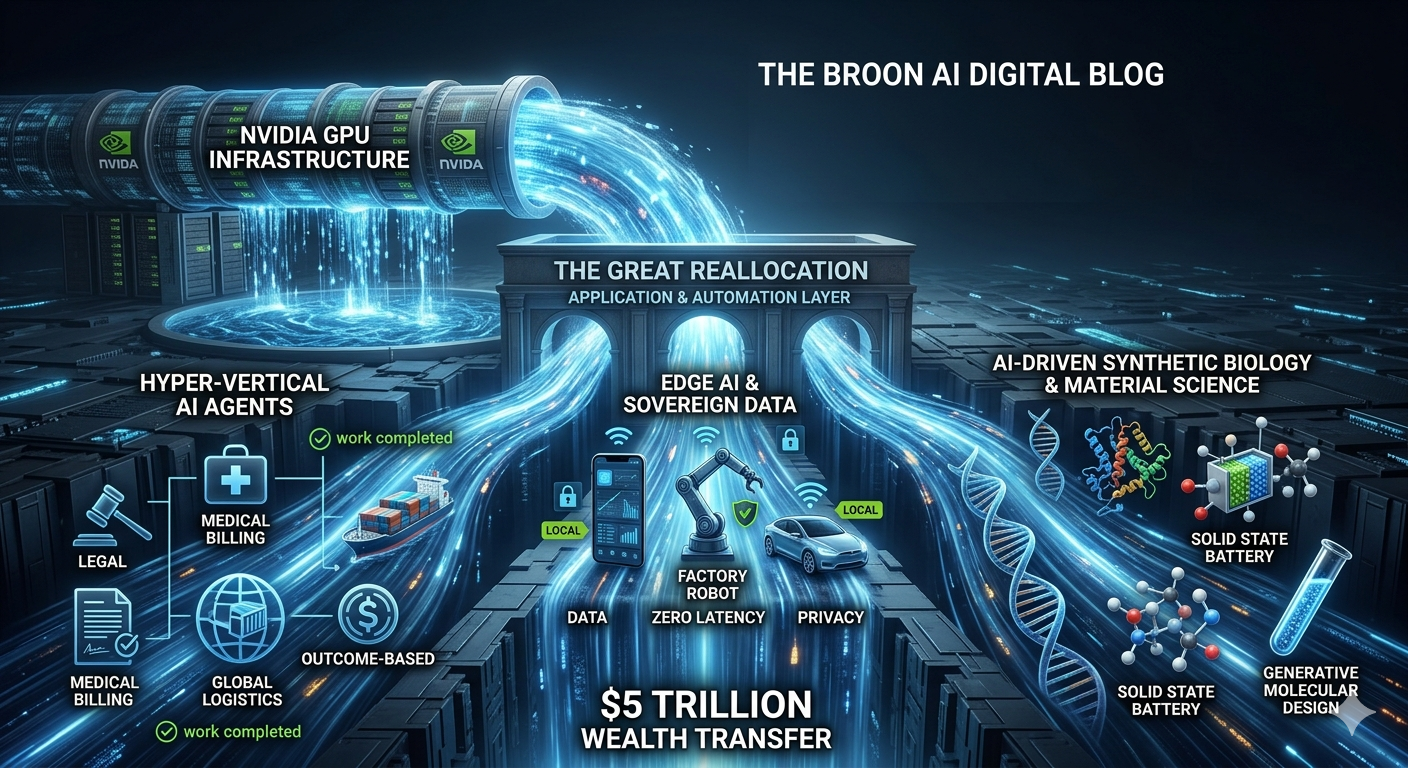

If you spent the last three years kicking yourself for not buying Nvidia (NVDA) at $150 before the colossal AI infrastructure run-up, I have some tough love for you: stop looking in the rearview mirror. The “Pick and Shovel” phase of the Artificial Intelligence gold rush—where all the capital flooded into GPUs, data centers, and massive foundational models—is reaching market saturation. The compute layer has been built. The real question is, what happens to the water once the plumbing is finished?
As an engineer who has spent the last decade building predictive models and analyzing tech sector capital flows, I can tell you exactly what is happening behind the closed doors of top venture capital firms right now. We are witnessing the most aggressive capital reallocation in tech history. The trillions of dollars that built the infrastructure are now violently pivoting into the Application and Automation Layer. The 2026 AI Value Chain Ecosystem has fundamentally shifted, and if you are still just looking at hardware, you are going to miss the actual $5 trillion wealth transfer.
“Infrastructure captures the initial hype, but vertical application captures the enduring monopoly. The models are commoditized; the workflows are where the alpha lives.”
According to the Q1 2026 Global Tech Capital Report released by Morgan Stanley, institutional investment in pure “foundational AI models” dropped by 22% year-over-year. Why? Because the cost of intelligence is trending to zero. Open-source models and intense competition between tech giants have made basic AI reasoning dirt cheap. The money isn’t in making the AI slightly smarter anymore; it is in aggressively deploying that cheap intelligence to eradicate massive enterprise bottlenecks.
Here are the three hyper-specific sectors where the smart money is moving right now, and where you need to focus your attention, career, and portfolio for the rest of 2026.
1. Hyper-Vertical AI Agents (The End of SaaS as We Know It)
We are moving past “copilots” that just help a human type an email faster. The massive capital influx is targeting Autonomous AI Agents built for hyperspecific industries. Think about legal discovery, medical billing, or global supply chain logistics. I recently consulted for a logistics startup that replaced a 40-person routing optimization team with a localized AI agent framework. It didn’t just save salaries; it reduced freight delay times by 18% globally.
The companies winning here aren’t selling software subscriptions; they are selling “work completed.” They price based on outcomes, not seats. The valuation multiples for startups that can prove end-to-end task automation in a specific vertical (like automating 100% of a hospital’s insurance claim rejections) are currently trading at 40x forward revenues.
2. Edge AI & Sovereign Data Processing
Sending petabytes of data to a massive centralized cloud is becoming economically and legally unviable. In 2026, privacy regulations and raw bandwidth costs have forced a pivot to “Edge AI.” This means running highly compressed, incredibly efficient AI models directly on local devices—smartphones, factory robots, and autonomous vehicles—without needing a constant internet connection to a server farm.
The money is flowing into companies developing advanced model compression techniques (like intense quantization and pruning) and specialized edge-silicon. I track companies creating localized AI that can process sensitive manufacturing defect data directly on the factory floor with zero latency. This sector is projected to grow at a staggering 68% CAGR through 2029.
3. AI-Driven Synthetic Biology & Material Science
This is the dark horse that is quietly absorbing billions. We are no longer just generating text and images; we are generating new physical reality. AI models are now predicting protein folding, discovering new battery materials, and formulating novel pharmaceuticals at a speed that makes traditional human lab work look like the Stone Age.
DeepMind’s AlphaFold was just the appetizer. In early 2026, a consortium of AI bio-techs utilized generative molecular design to identify a viable solid-state battery polymer in 14 days—a process that normally takes a decade of trial and error. The companies providing the proprietary datasets and the specialized AI simulation environments for pharmaceutical and chemical giants are poised to become the most valuable entities of the next decade.
Here is your strategic playbook for navigating this shift:
- Stop obsessing over foundational models: It doesn’t matter if OpenAI or Google “wins” the LLM war. They are becoming utilities, like electricity. Focus on the companies building the most vital appliances that plug into that electricity.
- Audit your own industry workflows: Where is the repetitive, high-friction, data-heavy bottleneck in your specific profession? The individuals who build or implement the AI agents to solve those specific problems will command massive premiums in the labor market.
- Follow the proprietary data: The moat in 2026 is no longer the algorithm; it is the data. Invest in or work for companies that own massive, unique, un-scrapeable datasets (healthcare records, proprietary financial transactions, industrial telemetry). They hold the raw fuel that every AI agent desperately needs to function.
The infrastructure phase created a few trillion-dollar hardware giants. The application phase is going to create tens of thousands of hyper-profitable, AI-automated monopolies across every sector of the global economy. Position yourself downstream, where the real value is being built.
#AIInvesting #TechTrends2026 #ValueChain #ArtificialIntelligence #TechStartups #VentureCapital #EdgeAI #AIAgents #FutureOfWork
Leave a Reply