TL;DR (Summary)
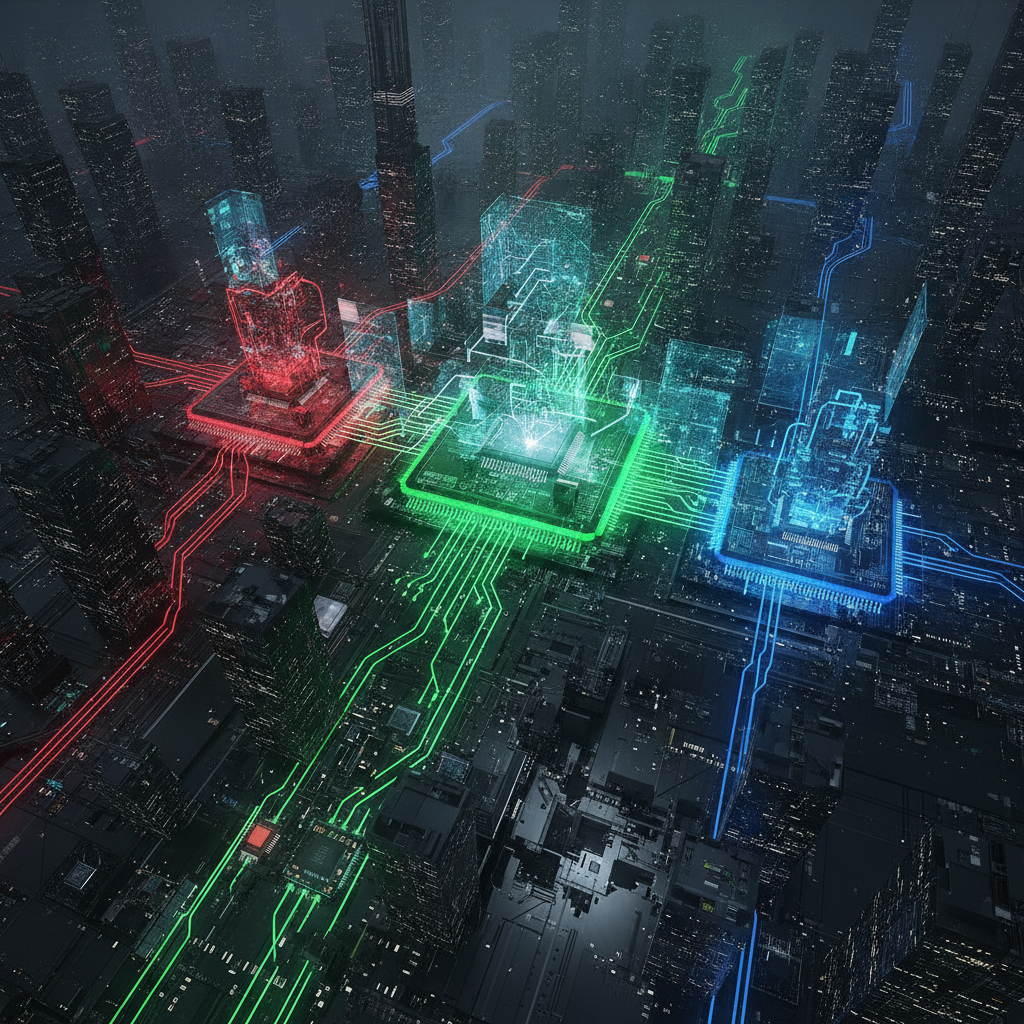
The 2026 semiconductor landscape will be a battleground for market leadership, with Nvidia’s AI dominance facing intense pressure from revitalized competitors. While Nvidia’s data center and AI GPU stronghold is undeniable, its recent market cap volatility signals underlying risks and the potential for shifts. AMD’s integrated solutions and growing data center presence, Intel’s aggressive foundry strategy and Gaudi accelerators, and Micron’s critical HBM advancements position them as formidable challengers. Emerging custom ASICs and geopolitical factors will further fragment the market, making sustained leadership a complex interplay of innovation, supply chain mastery, and ecosystem lock-in rather than a singular technological advantage.
Nvidia vs. Competitors 2026: Market Leadership? An In-Depth Semiconductor Analysis
The semiconductor industry, a foundational pillar of the global digital economy, is hurtling towards 2026 with unprecedented velocity and strategic realignments. At the epicenter of this tectonic shift lies Nvidia, a company that has redefined market capitalization metrics through its near-monopolistic grip on AI accelerators. Yet, the very exuberance that propelled Nvidia to stratospheric valuations also sows the seeds of intense competition and market recalibration. This analysis delves into the projected performance of Nvidia against its primary rivals — Micron, AMD, and Intel — and examines the broader implications of market cap fluctuations and the rise of other semiconductor giants as we approach the mid-decade.
Nvidia’s Enduring AI Dominance Amidst Volatility
Nvidia’s journey to becoming a trillion-dollar company has been primarily fueled by its CUDA ecosystem and the unparalleled performance of its GPUs in AI training and inference. By 2026, Nvidia is expected to maintain a significant lead in the high-end AI accelerator market, particularly within hyperscale data centers. Its strategic investments in software platforms like CUDA, Omniverse, and its continuous innovation in Hopper and Blackwell architectures (and subsequent generations) create a formidable moat. However, the recent market cap fluctuations — rapid surges followed by sharp corrections — highlight the inherent risks. These include over-reliance on a single, albeit massive, growth vector (AI), potential geopolitical headwinds impacting supply chains, and the increasing cost of next-generation manufacturing. Competitors are not merely playing catch-up; they are actively seeking to disrupt Nvidia’s ecosystem lock-in through open standards and alternative architectures. The question for 2026 isn’t if Nvidia will be a leader, but whether its dominance will be as absolute as it appears today, or if it will be forced to cede significant ground.
The Resurgence of Intel: Foundry, Gaudi, and Integrated Solutions
Intel, often seen as a sleeping giant, is undergoing a profound transformation aimed at reclaiming its historical market leadership. By 2026, Intel’s aggressive IDM 2.0 strategy, particularly its foundry services (Intel Foundry Services – IFS), will be a critical differentiator. This move aims to diversify revenue streams and position Intel as a vital player in global chip manufacturing, potentially challenging TSMC and Samsung Foundry. In the AI space, Intel’s acquisition of Habana Labs and its subsequent development of the Gaudi series of AI accelerators are gaining traction. Gaudi 3, and its successors by 2026, are designed to offer a compelling performance-per-dollar alternative to Nvidia, especially for inference workloads. Furthermore, Intel’s holistic approach — integrating CPUs (Xeon), discrete GPUs (Ponte Vecchio/Arctic Sound-M, and future generations), and AI accelerators — provides customers with a one-stop-shop for data center infrastructure. While catching Nvidia’s AI lead remains an uphill battle, Intel’s comprehensive portfolio and foundry capabilities make it a formidable competitor by 2026, capable of eroding Nvidia’s market share from multiple angles.
AMD’s Integrated Offensive: CPUs, GPUs, and Adaptive Computing
AMD’s strategy for 2026 is predicated on its strength in high-performance computing (HPC) and its unique position offering both leading CPUs (EPYC) and GPUs (Instinct series). The acquisition of Xilinx has further bolstered AMD’s portfolio with adaptive computing solutions (FPGAs), providing unparalleled flexibility for specialized AI and data processing tasks. By 2026, AMD’s MI300 series and its successors will be direct competitors to Nvidia’s top-tier AI GPUs, especially as AMD continues to refine its software stack to rival CUDA’s capabilities. Its ability to offer integrated CPU-GPU solutions — a single vendor for the core compute needs of a data center — presents a compelling value proposition. AMD’s focus on open software initiatives, like ROCm, also aims to break Nvidia’s ecosystem lock-in, attracting developers and enterprises seeking more vendor flexibility. The company’s consistent execution and strong product roadmap suggest that by 2026, AMD will be a much stronger contender in the AI and data center segments, chipping away at Nvidia’s market share through both performance and cost-effectiveness.
Micron’s Indispensable Role: HBM and Memory Innovation
While not a direct competitor in the GPU/CPU space, Micron’s role in the semiconductor ecosystem by 2026 is absolutely critical, particularly for the AI segment. As AI models grow exponentially, the demand for high-bandwidth memory (HBM) becomes paramount. Micron is a leading innovator in HBM technology, and its advancements directly impact the performance and efficiency of AI accelerators from Nvidia, AMD, and Intel. By 2026, the density, speed, and power efficiency of HBM (e.g., HBM3e, HBM4) will be a significant bottleneck or enabler for next-generation AI systems. Micron’s ability to deliver cutting-edge memory solutions will make it an indispensable partner for all AI chip designers. Its market cap, while not reaching Nvidia’s highs, reflects its foundational importance. Any disruption or innovation from Micron can have profound ripple effects across the entire high-performance computing landscape, indirectly influencing the competitive dynamics between the GPU giants.
Emerging Giants and Niche Disruptors
Beyond the established players, the 2026 landscape will also feature a growing number of specialized silicon providers and emerging giants. Companies like Graphcore, Cerebras Systems, and SambaNova Systems are pushing the boundaries of AI-specific architectures, offering alternatives for particular workloads. Furthermore, the rise of custom ASICs (Application-Specific Integrated Circuits), particularly from hyperscalers like Google (TPUs), Amazon (Inferentia/Trainium), and Microsoft, represents a significant threat. These internal developments reduce reliance on external vendors and can capture substantial market share for specific applications. Geopolitical factors also play a crucial role, with governments investing heavily in domestic semiconductor capabilities, potentially fostering new regional champions or disrupting existing supply chains. The collective impact of these niche players and custom solutions will be to fragment the market and intensify competition, making it harder for any single entity to maintain unchallenged dominance.
Projected 2026 AI/Data Center Semiconductor Market Dynamics
The following table provides a hypothetical projection of key metrics for the major players in the AI/Data Center semiconductor market by 2026, reflecting the trends discussed:
| Company | Projected 2026 AI Accelerator Market Share (Data Center) | Key Growth Driver(s) | Strategic Challenges | Ecosystem Strength (1-5, 5=Strongest) |
|---|---|---|---|---|
| Nvidia | ~60-65% | AI GPU innovation, CUDA ecosystem, Omniverse expansion | Rising competition, supply chain resilience, high R&D costs | 5 |
| AMD | ~15-20% | Integrated CPU/GPU solutions, ROCm, adaptive computing | Software maturity, scaling manufacturing capacity | 3 |
| Intel | ~10-15% | Gaudi AI accelerators, IFS (foundry), comprehensive data center portfolio | Execution consistency, regaining market trust, foundry ramp-up | 4 |
| Micron | N/A (Memory) | HBM innovation (HBM4/5), high-density memory solutions | Pricing volatility, technology transitions, geopolitical risks | N/A (Foundational) |
| Others (Custom ASICs, Startups) | ~5-10% | Specialized AI architectures, hyperscaler internal silicon | Scaling, market acceptance, funding sustainability | 2 |
Note: Market share figures are illustrative and focus specifically on high-performance AI accelerators within data centers. Total semiconductor market share would vary significantly.
Implications of Market Cap Fluctuations and Future Outlook
Nvidia’s market cap fluctuations are not just financial noise; they are indicators of investor sentiment regarding future growth potential and competitive threats. A massive valuation places immense pressure on a company to continuously deliver exponential growth, making it susceptible to corrections when challengers show promise. For 2026, the implications are clear:
- Diversification is Key: Companies relying on a single dominant product line will face increased scrutiny.
- Ecosystem Wars: The battle will extend beyond hardware to software platforms, developer tools, and open-source initiatives designed to break vendor lock-in.
- Supply Chain Resilience: Geopolitical tensions and the complexity of advanced manufacturing will make supply chain robustness a competitive advantage.
- Integrated vs. Best-of-Breed: Customers will weigh the benefits of integrated solutions (Intel, AMD) against specialized, best-of-breed components (Nvidia GPUs with specific CPUs/Memory).
The market for 2026 will be characterized by intense innovation, strategic partnerships, and aggressive pricing. While Nvidia is unlikely to be dethroned entirely, its absolute dominance will be challenged by the combined might of a resurgent Intel, an increasingly capable AMD, and the foundational support of memory giants like Micron, alongside a growing ecosystem of specialized disruptors. The concept of “market leadership” itself may evolve, becoming more segmented across different AI workloads, data center tiers, and geographical regions.
Conclusion: A Dynamic and Fragmented Future
The semiconductor market in 2026 will be far more dynamic and fragmented than ever before. Nvidia’s technological prowess and strategic foresight have positioned it at the forefront of the AI revolution, but its competitors are rapidly closing the gap with diversified strategies, robust roadmaps, and significant investments. Micron’s critical memory innovations underpin the entire high-performance computing ecosystem. The implications of Nvidia’s market cap fluctuations suggest a future where sustained, unchallenged leadership is increasingly difficult to maintain. Instead, 2026 will likely see a complex interplay of specialized strengths, strategic alliances, and intense competition, ultimately benefiting consumers and driving further technological advancement across the entire digital landscape. The race for true market leadership is far from over; it’s just entering its most exciting phase.
Leave a Reply