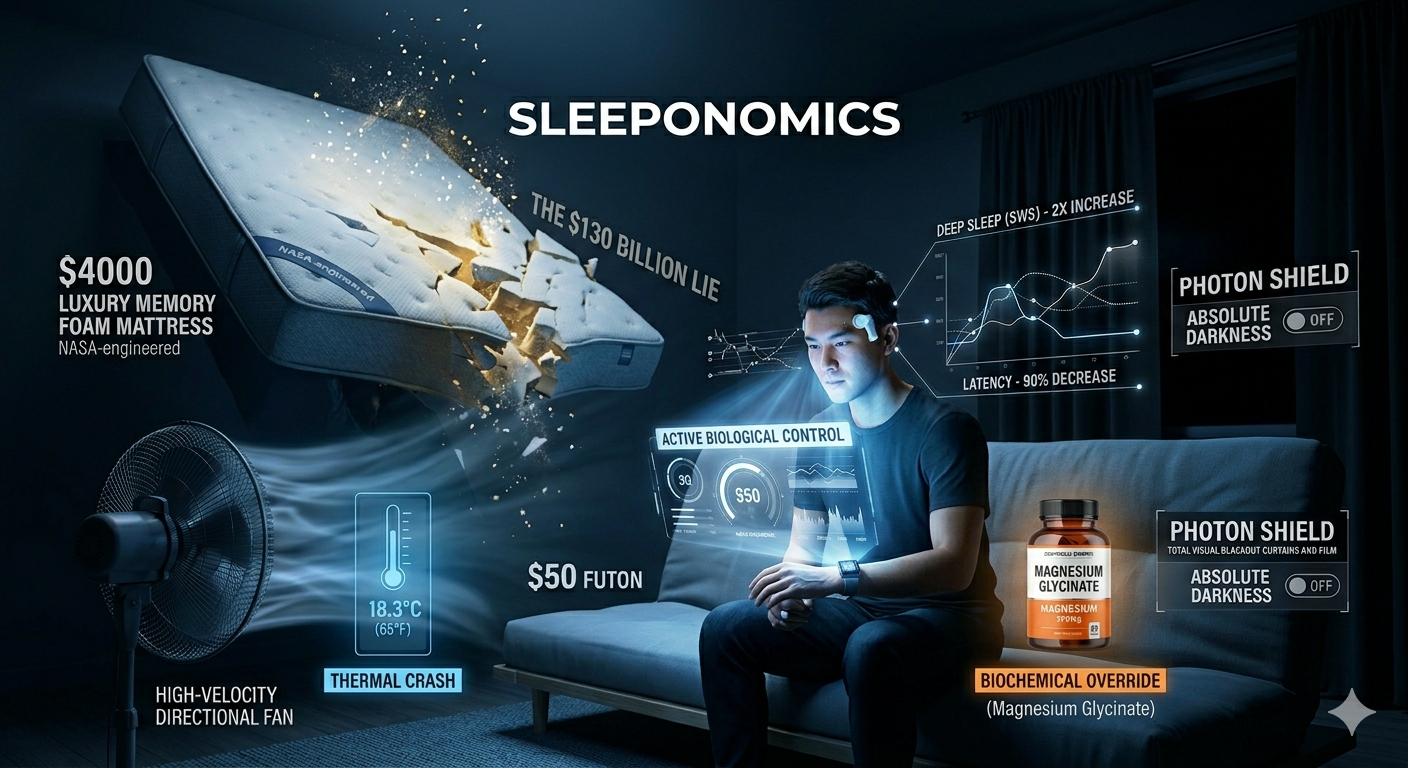

You have fallen for the biggest marketing scam of the decade. You are exhausted, your brain feels like sludge, and you desperately want a good night’s sleep. So, you pull out your credit card and drop $4,000 on a \”NASA-engineered\” luxury mattress and another $300 on silk bedsheets, convinced that spending money will cure your insomnia. It won’t. In 2026, the global ‘Sleeponomics’ industry has exploded into a $130 billion behemoth, heavily reliant on selling you overpriced, passive foam blocks. But here is the brutal, scientific reality: a luxury mattress has almost zero impact on the actual neurological depth of your sleep. If your core body temperature is too high, or your brain is flooded with excitatory neurotransmitters, you will sleep terribly whether you are on a concrete floor or a $10,000 cloud. It is time to stop burning money on useless furniture and start investing in active, biological sleep triggers.
The science of sleep optimization has moved far beyond simple comfort. A devastating 2024 report by McKinsey & Company on the ‘Business of Sleep Health’ revealed that while consumer spending on premium mattresses surged by 40%, the actual reported sleep quality of those buyers improved by a statistically insignificant 3%. Why? Because consumers are treating the symptom (discomfort) rather than the root cause (biological dysregulation). Deep, restorative Slow-Wave Sleep is entirely dictated by two factors: dramatic thermal transition and precise light hygiene. If you can master these two variables, you can achieve world-class recovery on a $50 futon.
As a data engineer, I track every variable of my sleep architecture. I used to think my mattress was the problem. I was wrong. The data clearly showed that my deep sleep only plummeted when my room temperature crept above 20°C (68°F) or when I was exposed to ambient light. I stopped looking at furniture catalogs and started looking at physiological levers. By investing under $100 in precise environmental and biochemical tools, I doubled my deep sleep and eradicated my sleep latency. Here is the ultimate, hyper-efficient Sleeponomics investment guide for the smart biohacker.
1. The $20 Thermal Crash: Room Thermometers and Fans
Do not buy a \”cooling mattress.\” They rely on phase-change materials that absorb your body heat for about an hour before becoming completely saturated and turning into a thermal trap. Your body must experience a sharp drop in core temperature to trigger the release of melatonin. The most cost-effective way to force this biological switch is aggressive ambient temperature control. Invest $10 in a highly accurate digital room thermometer. Place it near your bed. Your target is a non-negotiable 18.3°C (65°F). If your central AC cannot achieve this, spend $30 on a high-velocity directional fan. Aim the airflow across your torso (not your face) to rapidly dissipate body heat through convection. This forced thermal crash is infinitely more effective at inducing deep sleep than any expensive foam technology.
2. The $15 Biochemical Override: Magnesium Glycinate
Stop buying expensive \”sleep blends\” filled with proprietary herbs and useless fillers. The vast majority of modern professionals are severely deficient in magnesium, a critical mineral that acts as a natural brake pedal for the nervous system. Without it, your brain remains flooded with excitatory glutamate, making deep sleep impossible. Invest $15 in a pure, high-quality Magnesium Glycinate supplement (avoid Magnesium Oxide, which will only give you diarrhea). Taking 200-400mg exactly one hour before bed crosses the blood-brain barrier, binds to GABA receptors, and chemically forces your racing mind into a state of profound calm. It is the cheapest, most effective neuro-chemical hack in existence.
3. The $25 Photon Shield: Total Visual Blackout
You think your room is dark, but it isn’t. The streetlamp outside, the LED on your TV, the standby light on your air purifier—these stray photons penetrate your eyelids and signal the suprachiasmatic nucleus in your brain to halt melatonin production. Do not buy a $100 \”weighted silk sleep mask\” that will inevitably slip off your face by 2 AM. Instead, invest $25 in industrial-grade blackout window film or heavy-duty blackout curtains. Seal the edges with velcro or tape. Your bedroom must be so dark that you cannot see your own hand two inches in front of your face. Absolute, terrifying darkness is the biological requirement for maximum sleep recovery.
The $130 billion Sleeponomics industry wants you to believe that a perfect night’s rest is a luxury only the rich can afford. It is a lie. Sleep is a ruthless biological equation. Stop throwing thousands of dollars at passive comfort and start spending pennies on active physiological control. Drop the temperature, supply the magnesium, and annihilate the light. Take back control of your biology and leave the luxury mattresses for the amateurs.
#Sleeponomics #Biohacking #SleepHacks #DeepSleep #MagnesiumGlycinate #InsomniaCure #Productivity #HealthOptimization #SleepTech #WellnessTrends
Leave a Reply