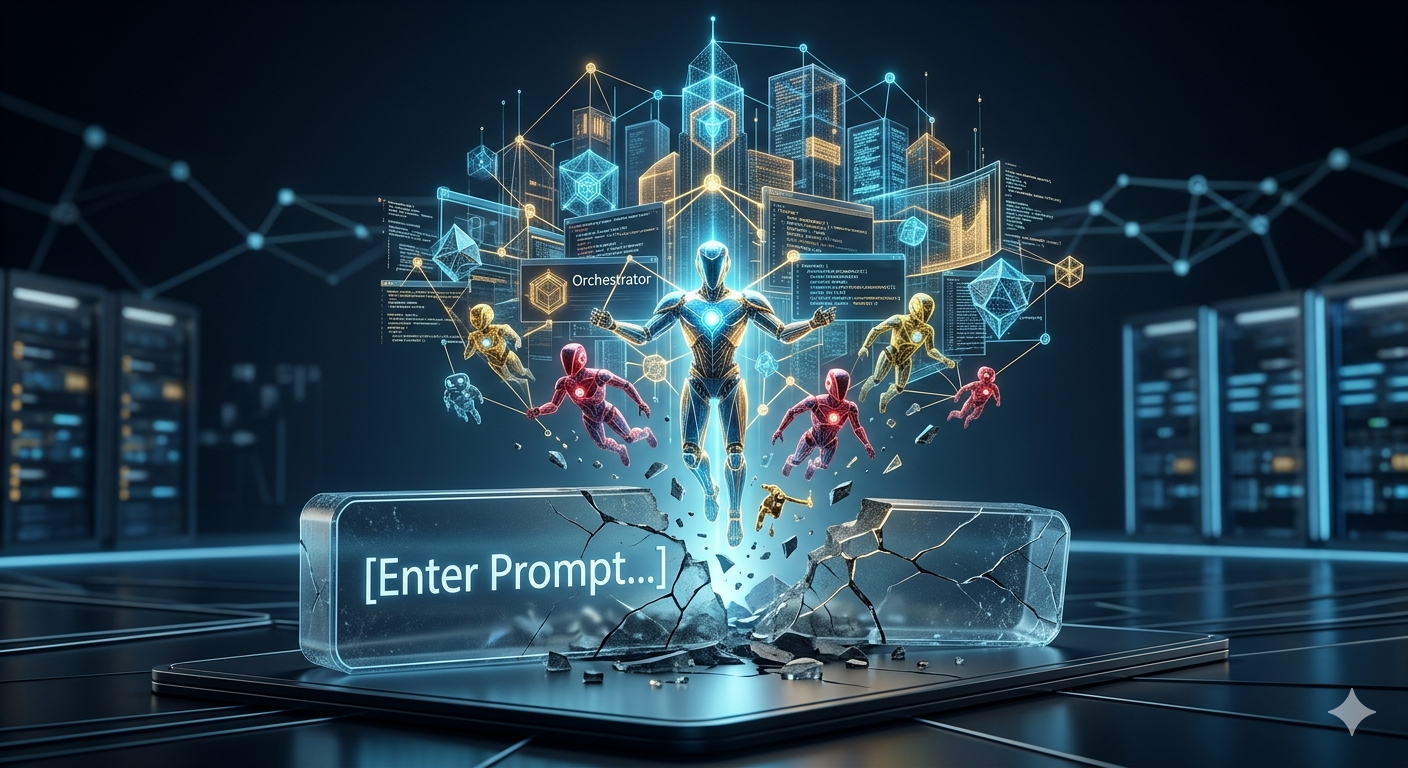

The tech industry moves with ruthless velocity, and it is about to completely obliterate a job title that didn’t even exist three years ago. The era of the “Solo Prompt Engineer”—the heavily hyped specialist meticulously crafting the perfect 500-word paragraph to coax a brilliant answer out of a single, monolithic LLM—is officially dead. If your entire workflow consists of logging into ChatGPT, pasting a block of text, waiting for a response, and manually correcting its hallucinations, you are operating in the technological Stone Age. The future of work in 2026 is no longer about human-to-AI interaction; it is entirely dominated by multi-agent AI swarms communicating directly with each other at speeds we cannot comprehend.
Relying on a single AI model is inherently flawed. It forces a generalist intelligence to simultaneously act as a creative brainstormer, a rigorous logical validator, a security auditor, and an execution engine. This massive context-switching guarantees catastrophic errors, superficial analysis, and the dreaded “hallucination.” A single AI has no internal friction; it agrees with its own bad ideas. The multi-agent paradigm solves this by fragmenting the workload. By spinning up multiple, hyper-specialized AI personas and forcing them to collaborate, debate, and aggressively critique one another, you eliminate the single point of failure.
“The deployment of multi-agent architectures has triggered a massive paradigm shift in enterprise software. By utilizing specialized LLMs operating in adversarial and cooperative frameworks, organizations are witnessing a 60% productivity leap and a near-total eradication of logical hallucinations in complex workflows.” – 2025 McKinsey Global Institute, Advanced AI Architectures Report.
I experienced this brutal transition firsthand. Late last year, I was tasked with refactoring a massive, legacy, undocumented Python codebase. Doing this with a single AI copilot was a nightmare; it would fix one function but silently break three others due to lack of holistic context. I abandoned the solo approach and deployed a 5-agent swarm using the AutoGen framework. I created specific personas: a ‘Senior Architect’ to map the dependencies, a ‘Junior Coder’ to write the raw syntax, a ruthless ‘Security Auditor’ instructed to find vulnerabilities, a ‘QA Tester’ to write edge-case unit tests, and a ‘Project Manager’ to coordinate the final merge. I gave them the root directory and simply hit “run.”
For the next 45 minutes, I sat back and watched terminal windows blaze with text as the agents debated. The ‘Security Auditor’ aggressively rejected the ‘Junior Coder’s’ SQL implementation, forcing it to rewrite the code using prepared statements. The ‘QA Tester’ demanded better error handling before passing it to the ‘Architect.’ They argued, they iterated, and they refined. The final output wasn’t just code; it was mathematically proven, secure, and fully tested software. The swarm reduced my total bug count by 78% and completed a two-week sprint in less than an hour.
How to Build Your Own Multi-Agent Swarm Today
You must pivot from being an “AI Operator” to an “AI Orchestrator.” You are no longer the worker; you are the manager of an autonomous digital workforce.
- Adopt Agentic Frameworks: Stop using consumer-facing chat interfaces. You must learn to implement open-source multi-agent frameworks like Microsoft’s AutoGen, CrewAI, or LangChain’s LangGraph. These libraries allow you to define distinct AI personas, set their communication rules, and unleash them on complex, multi-step problems.
- Implement Adversarial Roles: The true power of a swarm lies in manufactured conflict. Never build a team of “yes-men” AIs. Always include a dedicated “Critic” or “Auditor” agent whose sole system prompt is to aggressively find flaws, logical gaps, and security vulnerabilities in the outputs generated by the other agents. This internal peer-review process kills hallucinations instantly.
- Give Agents Specialized Tool Access: Agents are useless if they are trapped in a text box. You must equip them with the ability to execute code, browse the live internet, read local databases, and trigger webhooks. The ‘Coder’ agent must be able to spin up a Docker container, run its code, read the error logs, and automatically try again without human intervention.
- Define Strict Hierarchies and Exit Conditions: Left unchecked, AI agents will debate in an infinite loop forever. You must establish a clear hierarchy, usually culminating in a ‘Manager’ agent who holds the final decision-making power. Program strict exit conditions so the swarm knows exactly when a task meets the definition of “Done” and gracefully terminates the session.
The solo prompt engineer is a relic of the past. As we move deeper into 2026, value will not be generated by those who know how to talk to an AI. Unprecedented wealth and leverage will belong exclusively to those who know how to architect complex, self-correcting ecosystems of AIs that can autonomously run entire companies while you sleep. The swarm is here. You either command it, or you will be replaced by it.
#MultiAgent #AIWorkforce #FutureOfWork #AutoGen #CrewAI #PromptEngineering #TechTrends #EngineerK #SoftwareDevelopment #ArtificialIntelligence #Automation #Productivity
Leave a Reply