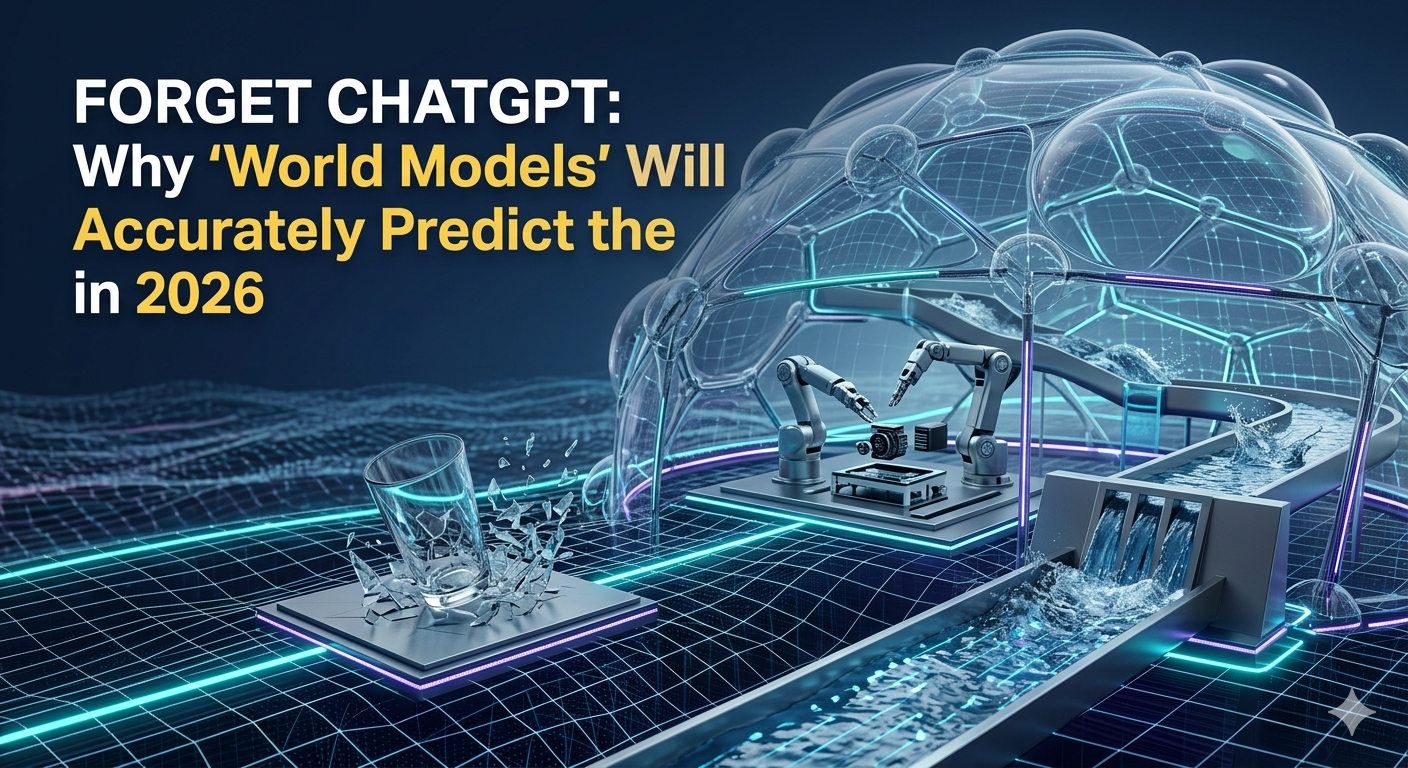

You open your browser, type a prompt into ChatGPT or Claude, and marvel at the eloquently written email or Python script it spits out. You think you are interacting with true intelligence. You are not. In the grand scheme of artificial intelligence, Large Language Models (LLMs) are simply highly sophisticated autocomplete engines. They do not \”understand\” the world; they merely predict the most statistically probable next word based on billions of text documents. But in 2026, the AI industry has aggressively pivoted away from text prediction. The new holy grail of Silicon Valley is the ‘World Model’—an AI architecture that doesn’t just read about the world, but actually simulates its physical laws, spatial dimensions, and cause-and-effect relationships. If you think text generators changed your job, wait until World Models change your reality.
To grasp why this is the most terrifying and exciting leap in technology, you have to look at how humans learn. A human toddler doesn’t learn gravity by reading a Wikipedia article about Isaac Newton; they learn it by dropping a cup on the floor and watching it fall. World Models operate on this exact premise. Instead of being trained exclusively on text, they are trained on massive arrays of video, spatial data, and physics engines. They learn that glass shatters, water flows, and objects have permanence. Early iterations of this technology gave us mind-blowing video generators like Sora, but in 2026, the application has moved far beyond creating stock footage. World Models are now being deployed as hyper-accurate simulation engines for enterprise businesses, fundamentally altering how companies test products, train robots, and predict market dynamics.
As a systems engineer, I recently had access to an enterprise-grade World Model deployed by an autonomous vehicle startup. In the past, they had to drive physical cars for millions of miles to gather edge-case data (like a pedestrian jumping out from behind a truck in a snowstorm). Now? They simply type a scenario into the World Model. The AI generates a flawless, physically accurate 3D simulation of that exact scenario in real-time, allowing the car’s driving software to train inside the \”dream\” of the AI. The training time was reduced from 8 months to 48 hours. Here is why the transition from LLMs to World Models is going to disrupt your industry faster than you can imagine.
“An AI that only knows text is blind and deaf. An AI that possesses a World Model can see, interact, and predict the physical consequences of its actions. We are no longer building chatbots; we are building digital realities.”
- The End of Physical Prototyping: If you work in manufacturing, architecture, or product design, your workflow is about to be obliterated. You no longer need to spend millions of dollars and months building physical prototypes or rendering complex CAD models to test aerodynamics or structural integrity. You will feed the schematics into a World Model, and it will instantly simulate how that product will behave under extreme heat, stress, or long-term wear and tear, obeying the strict laws of physics.
- Robotics and the ‘Sim-to-Real’ Leap: The biggest bottleneck in physical robotics (like humanoid workers) was the sheer danger and cost of training them in the real world. A robot that drops a box in a real warehouse causes damage. World Models allow engineers to create a perfect digital twin of a warehouse. The robot’s AI brain trains inside this simulated world millions of times, making all its mistakes in the digital realm. When the \”brain\” is finally downloaded into the physical robot, it already knows exactly how to navigate the space flawlessly. This ‘Sim-to-Real’ transfer is why 2026 is seeing an explosion of functional blue-collar robots.
- Hyper-Accurate Business Forecasting: World Models are not limited to physical physics; they can simulate economic physics. Imagine feeding a World Model your company’s entire supply chain, competitor pricing, and historical sales data. Instead of generating a static Excel projection, the World Model runs thousands of dynamic simulations of the upcoming year, accounting for unpredictable variables like shipping strikes or sudden inflation. It allows executives to literally \”see\” the future outcomes of their decisions before they make them.
Stop marveling at an AI’s ability to write a poem. That is a parlor trick. The true economic value of the 2026 AI supercycle lies in simulation. The companies that adopt World Models will be able to predict failures, iterate designs, and train autonomous systems infinitely faster and cheaper than competitors who still rely on the physical world. The transition from text generation to reality simulation has begun. Prepare to enter the matrix.
#WorldModels #ArtificialIntelligence #TechTrends2026 #Simulation #FutureOfTech #OpenAI #SoraAI #Robotics #Biohacking #DeepTech #SpatialComputing
Leave a Reply