TL;DR (Summary)
NVIDIA’s adoption of direct liquid cooling for its high-power GPUs is a disruptive force, shattering the thermal limits of traditional air cooling to enable unprecedented compute density. This innovation is a catalyst for the rise of small, hyper-efficient AI data centers, allowing organizations to deploy hyperscale power in a compact footprint. The move drastically lowers Power Usage Effectiveness (PUE), reduces operational costs, and creates a new ecosystem of winners in liquid cooling infrastructure, while challenging legacy air-based facility designs.
The Unyielding Physics of the Thermal Wall
The AI gold rush has a dirty secret: heat. For every petaflop of processing power we gain, we generate a corresponding thermal load that threatens to melt our progress. Air cooling, the workhorse of the data center for decades, is gasping for breath. It’s a simple matter of physics. We’ve been living on borrowed time.
The demand for AI compute is on an exponential tear. A single NVIDIA H100 GPU can draw over 700 watts, and the next-generation Blackwell B200 is expected to push well past the 1000-watt (1kW) mark per chip. A standard server rack packed with these processors becomes a multi-kilowatt furnace, easily exceeding 50-80kW. Air, as a medium for heat transfer, simply cannot remove this concentrated thermal energy efficiently enough. This creates a phenomenon known as “stranded capacity”—data centers with enough electrical power and physical space but insufficient cooling capability to fully populate their racks with the latest AI accelerators. We are hitting a hard wall of physics, and air is the fundamental bottleneck.
NVIDIA’s Pivot: A Strategic Necessity, Not a Choice
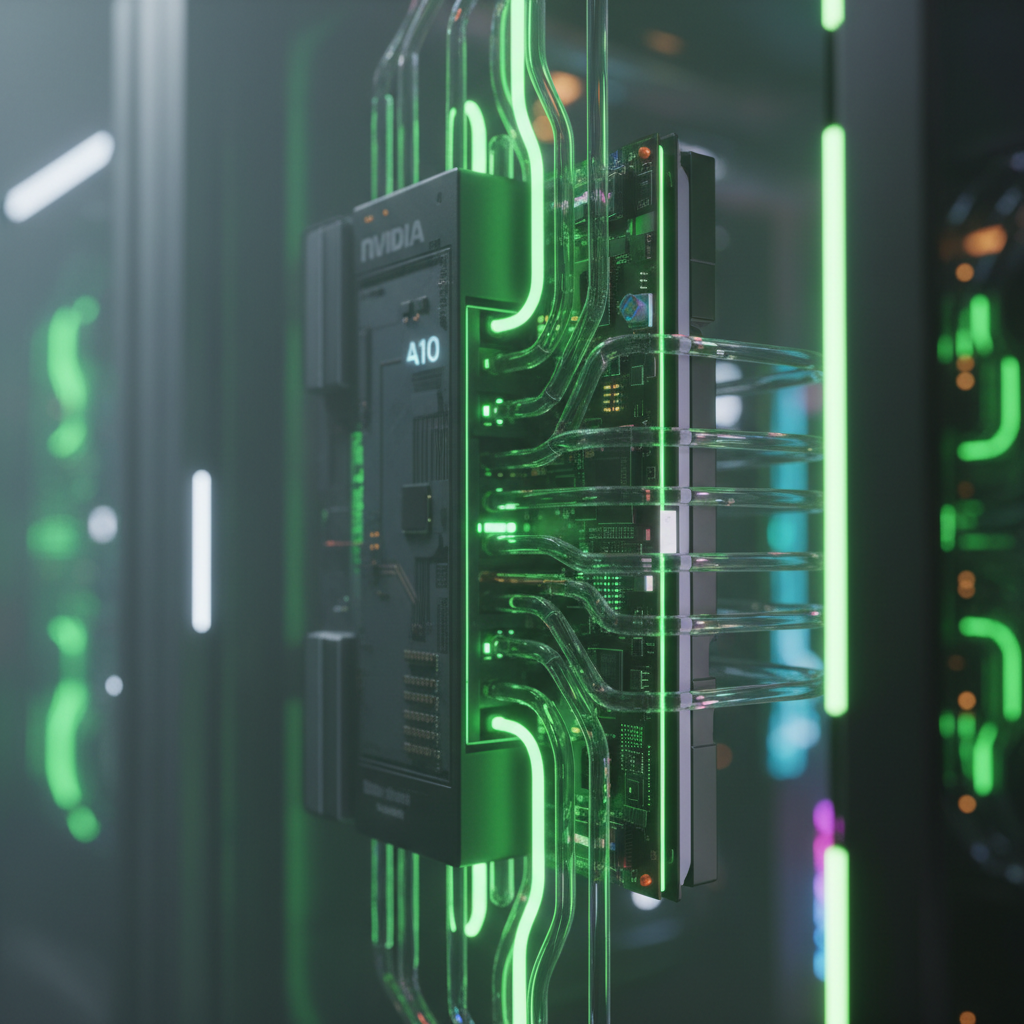
NVIDIA’s move to integrate and champion liquid cooling is not a mere feature update; it’s a foundational re-architecture driven by strategic necessity. Direct-to-chip (DTC) liquid cooling, the primary technology being deployed, involves piping a coolant (like treated water or a dielectric fluid) through a closed loop directly to a cold plate. This metal plate sits on top of the GPU die and other hot components like high-bandwidth memory (HBM).
This method is orders of magnitude more efficient at heat transfer than blowing air across a finned heatsink. But why now? Because NVIDIA’s entire performance roadmap for future GPUs is impossible without it. To pack more transistors, run them at higher frequencies, and stack them closer together in advanced packaging, you must solve the heat problem directly at its source. This allows NVIDIA to deliver on its promise of ever-increasing performance, ensuring their continued dominance in the AI hardware market. It’s a moat-building strategy disguised as a thermal solution. By dictating the cooling standard, they control the ecosystem and accelerate the obsolescence of infrastructure not designed for their future products.
The Devastating Impact on Small AI Data Centers
While massive hyperscalers like Google and Microsoft have been experimenting with liquid cooling for years, NVIDIA’s official embrace of the technology effectively democratizes it for the entire market. The most profound impact, however, will be felt not in the sprawling cloud campuses, but in the compact, decentralized AI data centers of the future—the kind run by enterprises, research universities, sovereign cloud initiatives, and startups.
Unleashing Unprecedented Rack Density
The primary benefit is a staggering increase in compute density per square foot. With legacy air cooling, a standard rack might be thermally limited to 15-20 kW to manage heat rejection. With a properly designed direct liquid cooling solution, that same rack can handle 80 kW, 100 kW, or even more. This is not an incremental improvement; it is a step-change in capability. A small business or a university research lab can now deploy the AI processing power of an entire data hall from a decade ago into just two or three server racks. This completely transforms the economics of on-premise AI, removing massive real estate as a prerequisite for world-class computing.
The Efficiency Revolution: PUE Plummets
Power Usage Effectiveness (PUE) is the gold-standard metric for data center efficiency, representing the ratio of total facility power to IT equipment power. An ideal PUE is 1.0. Air-cooled facilities, with their massive fans, chillers, and pumps, often struggle to get below a PUE of 1.4, meaning for every watt delivered to a GPU, another 0.4 watts is wasted on cooling. Liquid cooling is a game-changer for this metric.
| Metric | Legacy Air Cooling | Direct Liquid Cooling (DLC) | Impact |
|---|---|---|---|
| Typical Rack Density | 10-20 kW/rack | 80-120+ kW/rack | 4-6x Increase in Compute Density |
| Average PUE | 1.4 – 1.6 | 1.05 – 1.2 | Up to 40% Reduction in Energy Waste |
| Facility Footprint | Large (Requires space for CRAHs/AHUs) | Compact (Minimal air handling needed) | Reduced Capital Expenditure on Real Estate |
Ecosystem Shockwaves and the New World Order
This architectural shift creates a new set of winners and forces incumbents to adapt or perish. Companies specializing in liquid cooling hardware—like Vertiv, CoolIT Systems, and Motivair—are now at the center of the AI infrastructure boom. Manufacturers of leak-proof quick-disconnect couplings, high-performance coolants, and intelligent Coolant Distribution Units (CDUs) will see explosive growth. System integrators who can design and deploy these complex, liquid-fed systems will become invaluable.
Conversely, legacy providers focused solely on air cooling infrastructure face an existential threat in the high-performance computing market. Colocation data centers that cannot offer liquid cooling as a native, high-density service will be unable to attract premium AI workloads. They must invest and re-tool their facilities immediately, or risk becoming technologically obsolete.
Conclusion: The Dawn of the Compact AI Supercomputer
NVIDIA’s deliberate and forceful adoption of liquid cooling is far more than a technical footnote. It is the critical enabler for the next phase of global AI deployment. It breaks down the physical and economic barriers that once reserved supercomputing power for an elite few. By solving the heat problem at the chip level, NVIDIA has unlocked the potential for a worldwide network of smaller, denser, and radically more efficient AI data centers. This is not an evolution; it is a disruptive innovation that will fuel AI progress for the next decade, from the network edge to the enterprise core. The era of the air-cooled AI behemoth is ending; the age of the liquid-cooled, compact AI powerhouse is just beginning.
Leave a Reply